Blackwork high contrast tattoos range from a single white accent on solid black to full biomechanical sleeves that take multiple sessions and years of maintenance.
What separates one design from another is where you want it to live and how much of your skin you’re willing to commit.
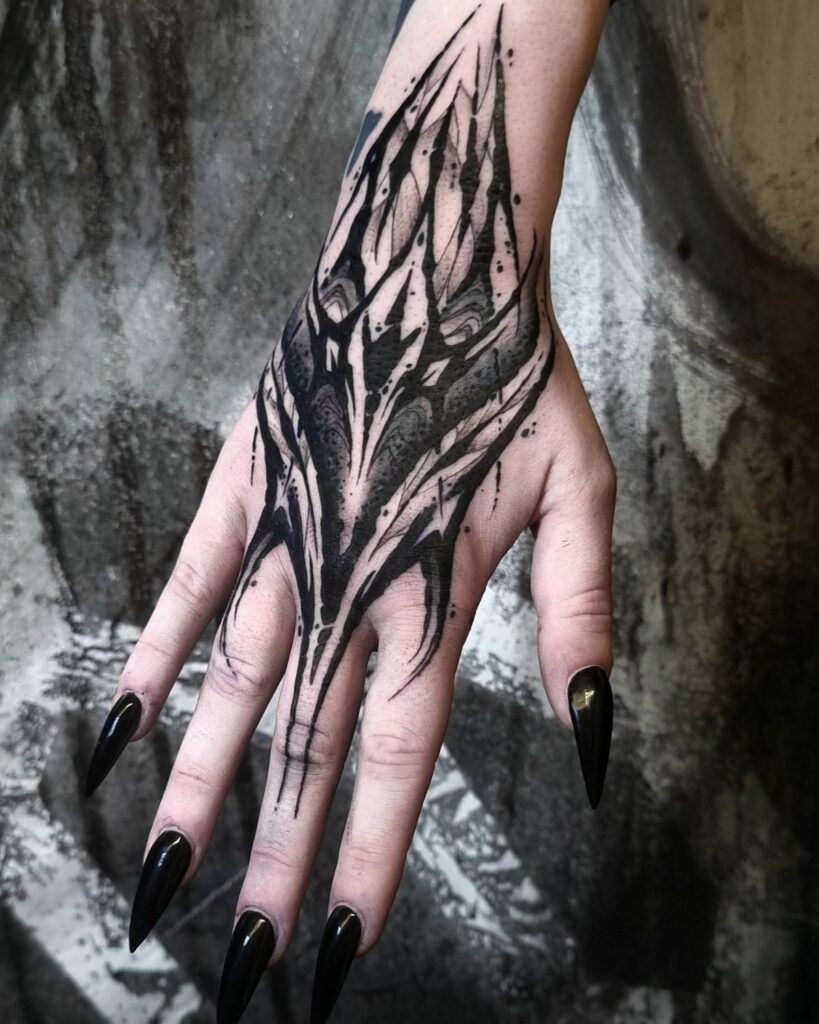
A blackout forearm with root lines threading onto the hand heals dark and heavy, and that hand detail will need refreshing within a few years.
1. Geometric Blackwork
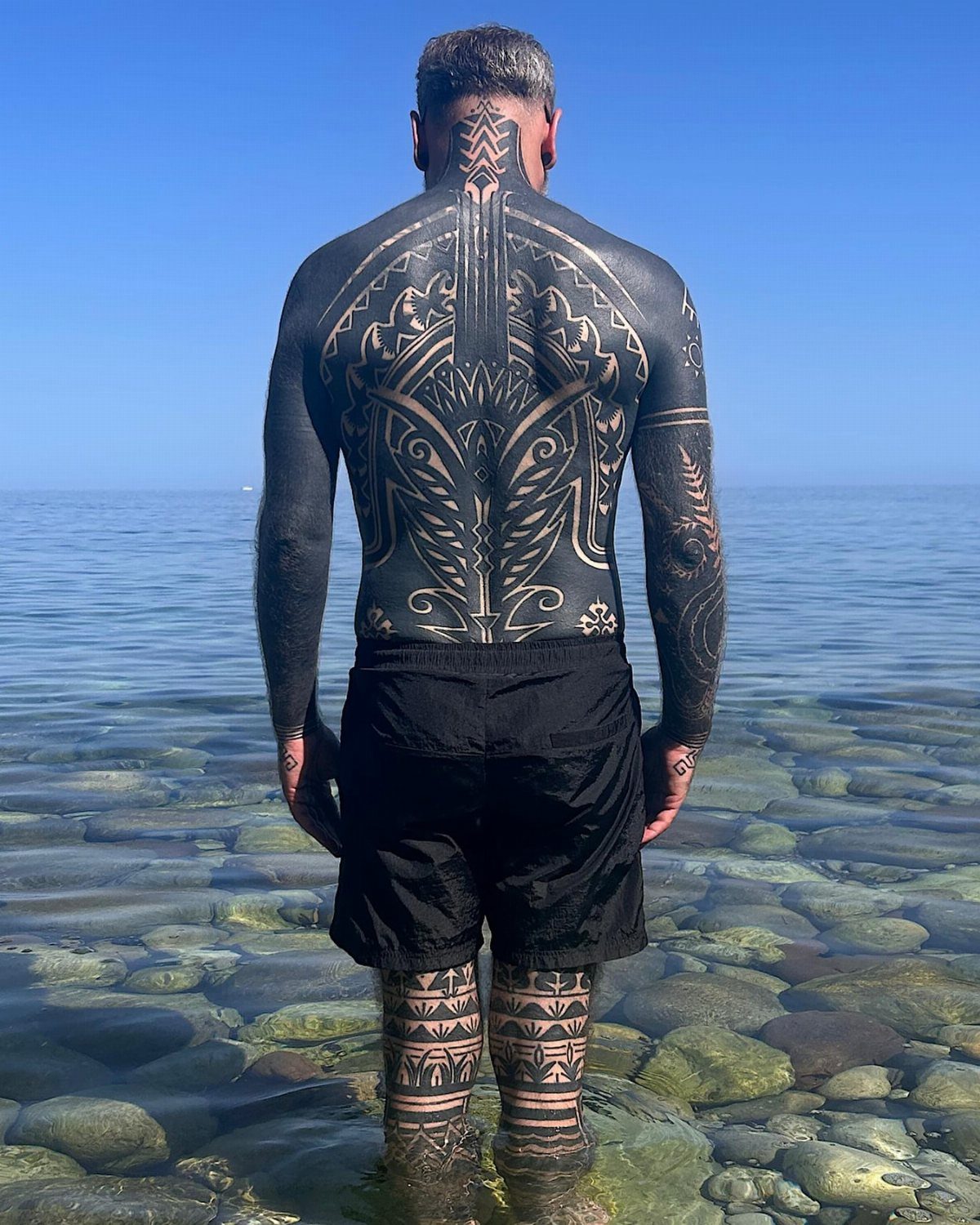
Symmetry in pure black ink hits different when the pattern wraps a whole limb or spreads across a back.
Sacred geometry, mandalas, labyrinths, these shapes carry weight in traditions far older than tattooing itself, and blackwork lets that history sit right against the skin.
The thigh, the forearm, the full back: larger areas let the pattern breathe and flow without breaking. A sleeve built this way reads almost hypnotic, the eye keeps finding new intersections.
Geometric blackwork does not leave room for later change; what you commit to stays.
Geometric blackwork ages best when the lines stay crisp, which means finding someone who measures twice and inks once. A mandala that drifts half an inch off center turns from meditation to headache fast.


2. Tribal and Cultural Blackwork
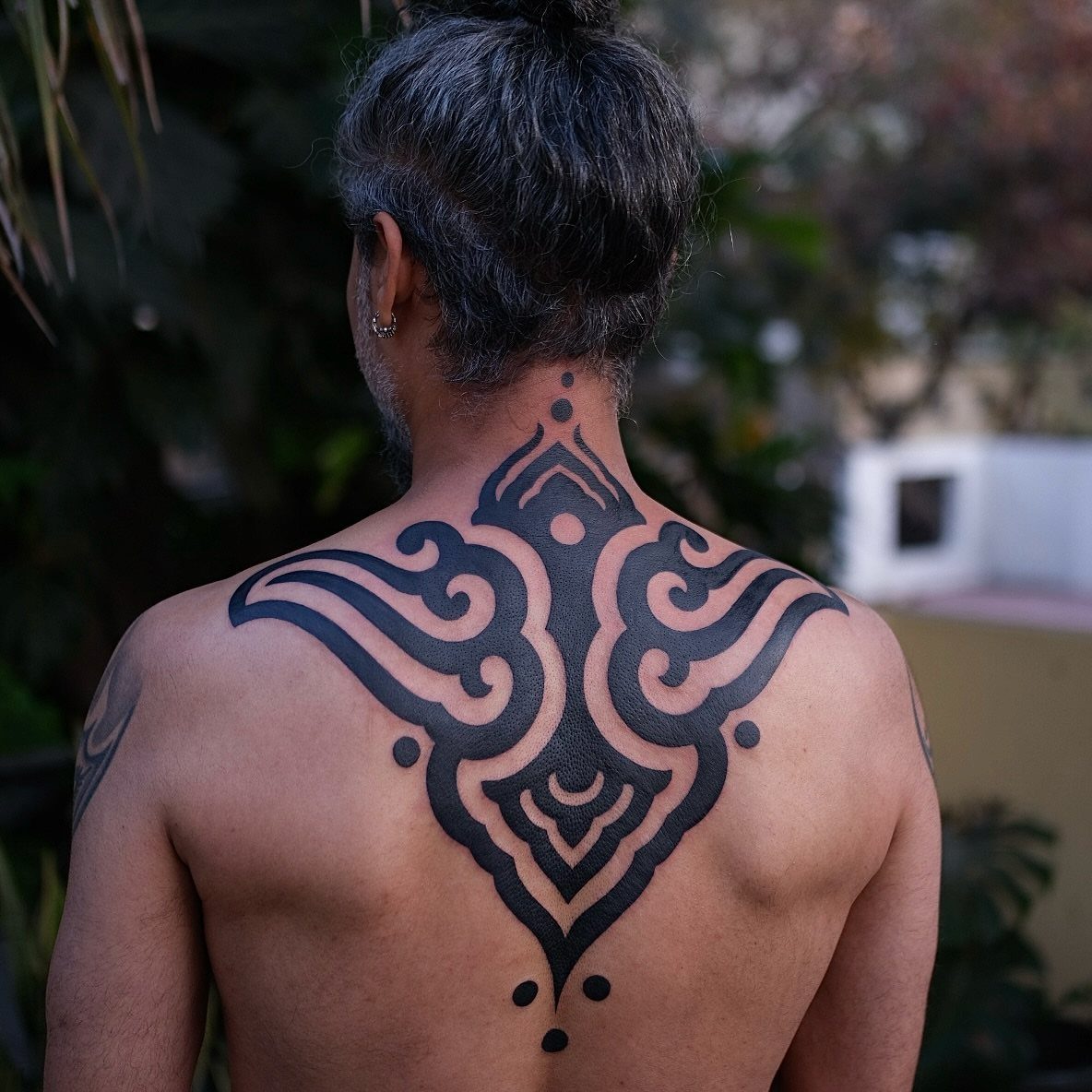
Bold lines and repeating patterns carry stories that predate Instagram by centuries.
Tribal blackwork pulls from indigenous traditions where every mark meant something: lineage, status, protection. The patterns look ancient because they are.
What works now is the structure itself. Clean angles, symmetrical layouts, motifs that reference real cultural roots rather than generic "tribal" flash.
A forearm band or full sleeve holds this well; the repetition lets the eye rest in the pattern. Dense blackwork can still feel open when the shapes are balanced against each other.
Research matters here.
Wearing patterns tied to cultures not your own without understanding them is a choice some make and others regret. The design should mean something you can explain, or at least choose knowingly.


3. Blackwork Tattoo on Thighs
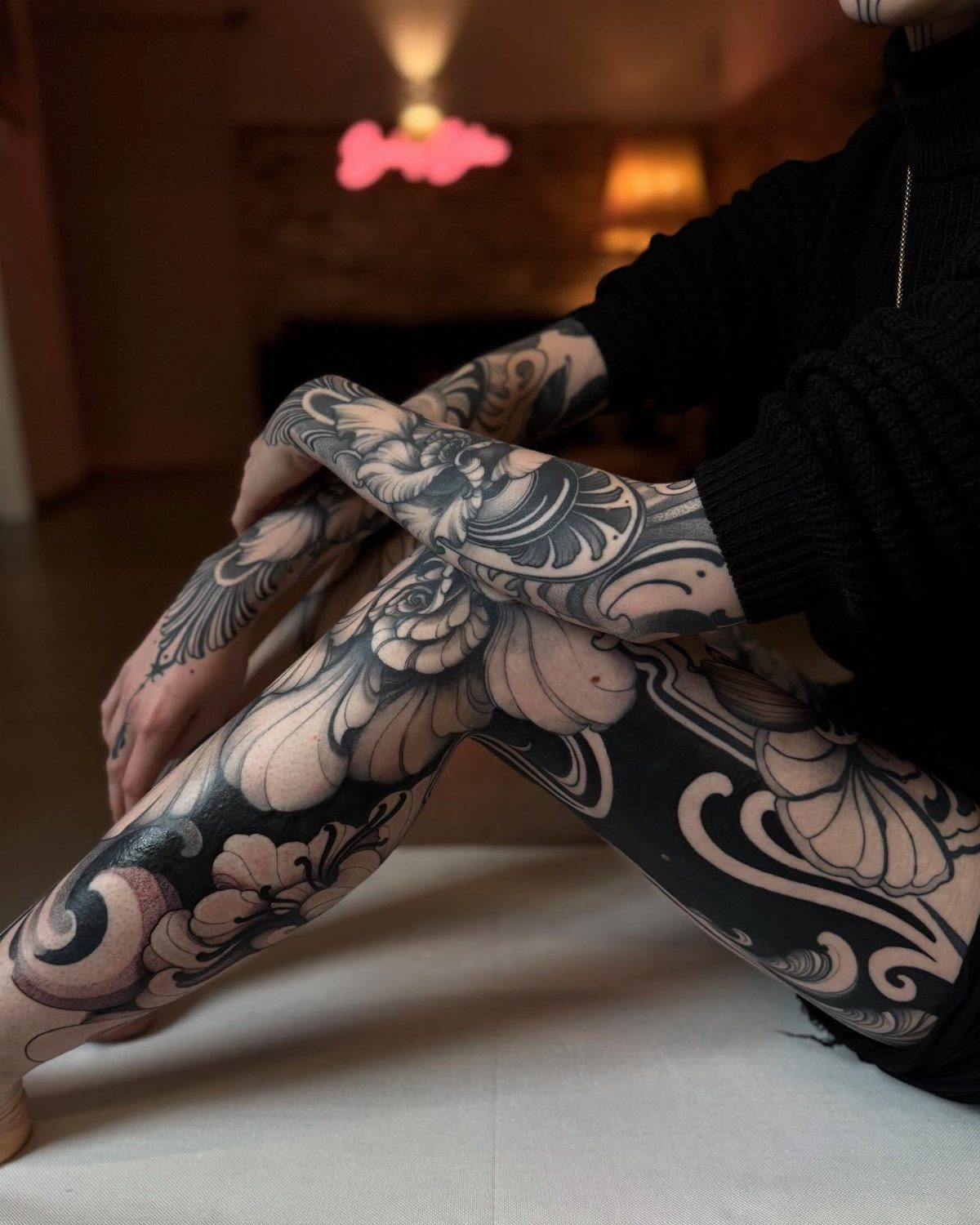
Thighs hide easily and show dramatically, which makes them ideal for blackwork at scale.
The natural curve of the muscle gives snakes, florals, beasts a sense of movement that flat skin cannot match. Soft tissue here takes ink smoothly; solid black fills read richer, smoother, almost velvet against the surrounding skin.
Privacy is the other advantage.
A piece this size stays yours until you decide otherwise. Ornamental and floral thigh coverage from hip to knee takes multiple sessions and heals best with the leg elevated when possible.
Plan for swelling.
The thigh bruises and bloats more than a forearm, so booking sessions with recovery time between them keeps the line quality consistent. Loose shorts, not jeans, for at least a week after.


Innovative Skin-Sync Technology: We don't just sit on the skin; we interact with it. By reacting organically with naturally occurring proteins in your skin's outermost layer (stratum corneum), our plant-based formula magically transforms from a transparent guide into a rich, ultra-realistic navy-black. It looks exactly like a healed, permanent tattoo—without the needles or depth.
4. Illustrative Blackwork
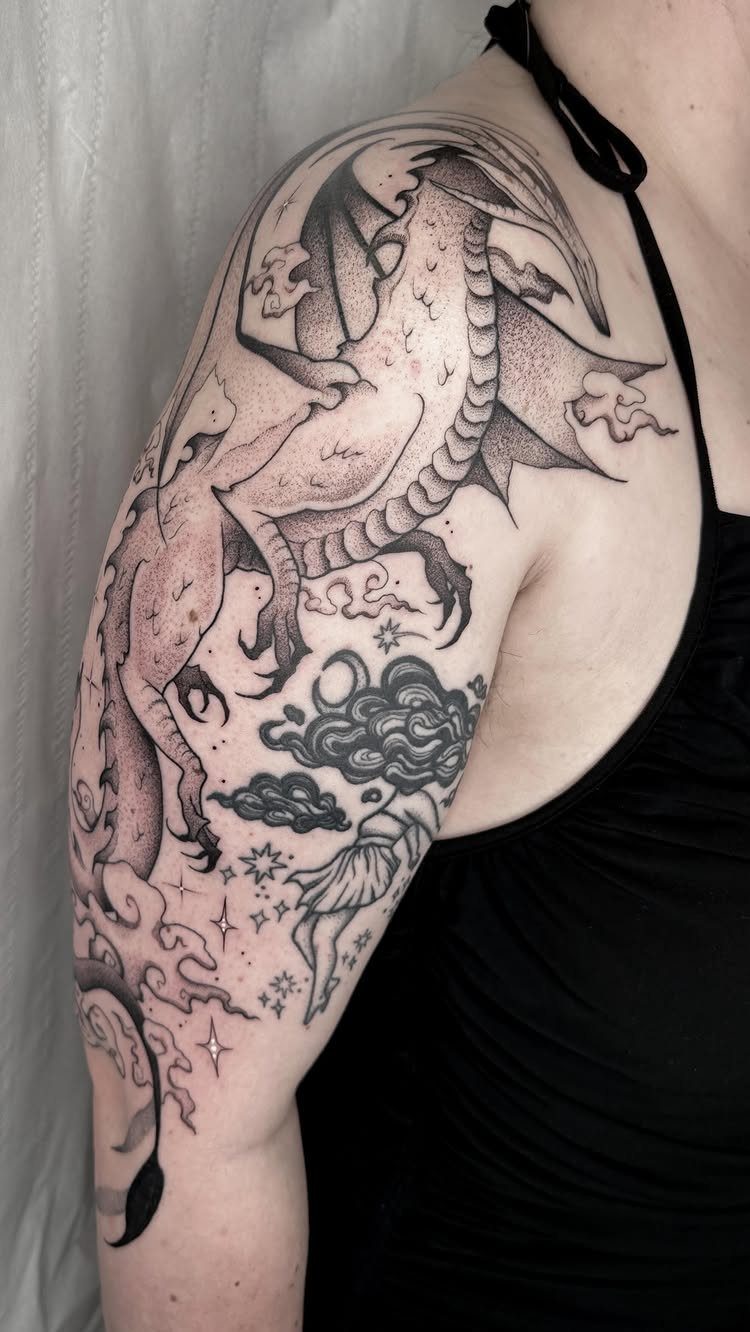
A dragon above clouds and stars, drawn only in black, proves how much detail one color can hold.
Illustrative blackwork treats the skin like paper, aiming for the depth of a graphite drawing or an ink illustration rather than the flat punch of traditional blackwork.
Portraits, creatures, celestial scenes all fit here; the limitation is the artist, not the ink.
Illustrative blackwork at this scale takes two full day sessions. That sitting time matters.
Illustrative work needs the skin steady, the artist fresh, the stencil intact. Rushing it shows in blurred scales or muddled cloud edges.
This style suits someone who wants a specific image, not just a pattern. Fine lines in pure black soften faster than bold geometry, so placement away from sun and joint movement helps the detail hold.

Triple Blackout Tattoo Ink - Strengthen your shading with Triple Blackout, the boldest black designed for greater dimension in your tattoos. With a glycerin free formulation, this professional tattoo ink inserts smoothly into the skin for excellent distribution and shading.

MADE IN THE USA SINCE 1990: For over 30 years Dynamic Color has produced professional tattoo ink in the United States, an established American brand artists built their work on long before most imported labels existed.

Ultra-Thin Black Ink - This all-around black tattoo ink delivers the thinnest consistency without glycerin, offering super-smooth flow and rapid saturation for high-speed precision during lining and shading.
5. Dotwork Shading Tattoo
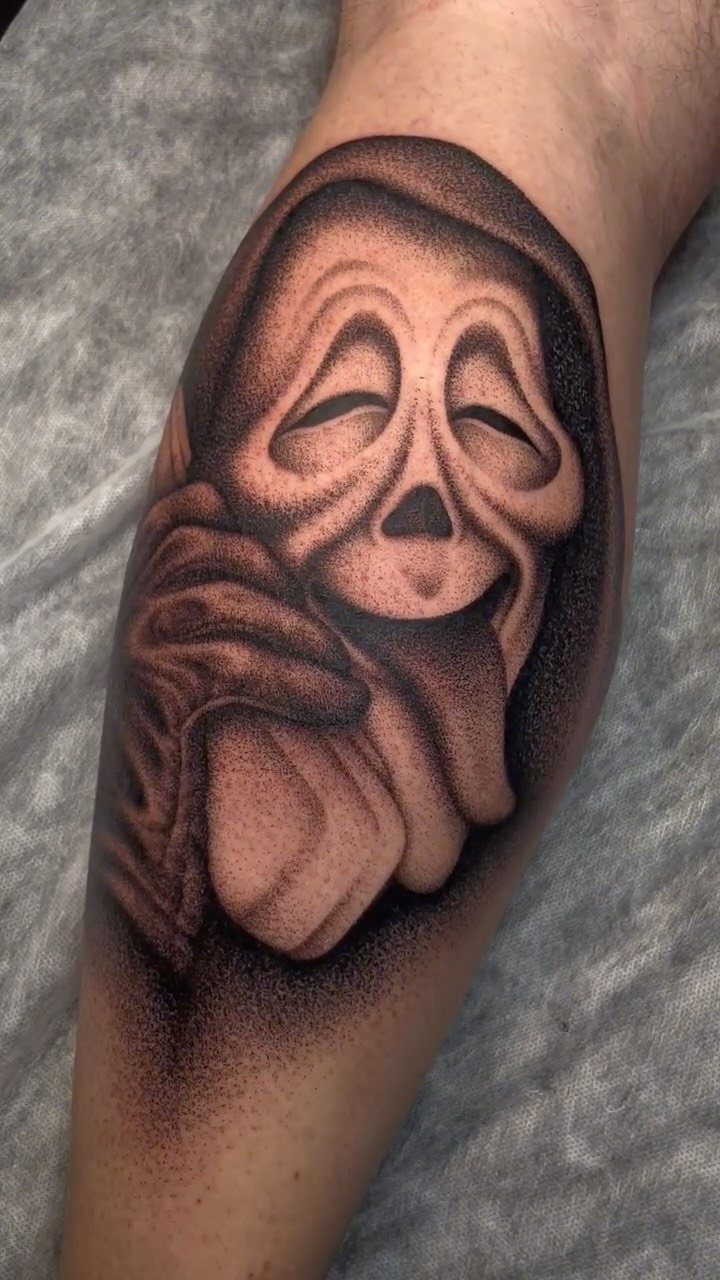
Shadow and texture can be built from thousands of tiny dots instead of traditional shading lines. Dotwork turns flat black into something almost three-dimensional; stippling gives weight and surface texture that solid fill cannot manage.
This technique softens blackwork’s usual harshness.
Animal fur, night skies, spiritual symbols all gain a handmade quality, the eye reads the texture before the image. Calf muscle holds steady for dense dotwork, letting the artist work methodically.
The risk is time.
Dotwork at this density takes hours longer than whip shading or solid fill. A simpler design with dotwork accents might suit a first piece, or a smaller area, before committing to a full portrait built from stipple alone.


6. Negative Space Skin Breaks Tattoo
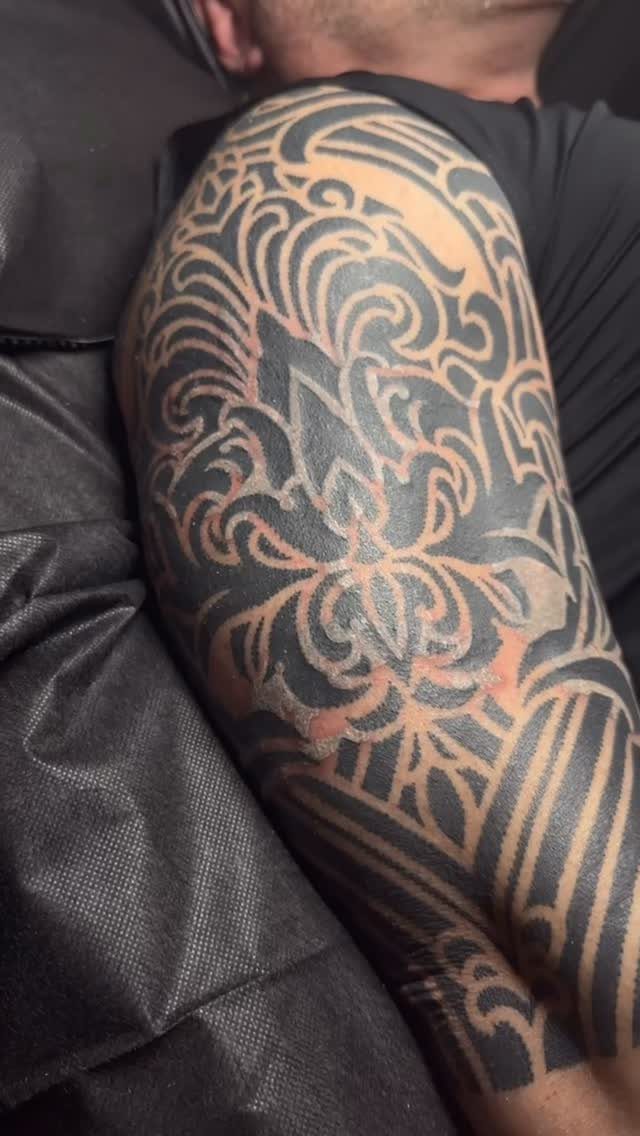
Leaving skin bare is its own kind of drawing. Un-inked breaks in swirling blackwork form patterns that the ink only frames; the negative space becomes the design as much as the black.
This keeps dense work from turning into a heavy blob, lets the piece breathe, can even hide secondary images for the eye to find later.
The technique demands planning. Every break in the black is a shape that must hold its own; too many and the design fragments, too few and the contrast is lost.
On curved surfaces, breaks that follow muscle flow let the pattern move with the body.
This approach suits someone who wants blackwork’s boldness without the weight of total coverage. As black ink settles and spreads slightly, skin breaks need to have been sized generously enough to stay distinct.


7. White on Black Inverted Tattoo
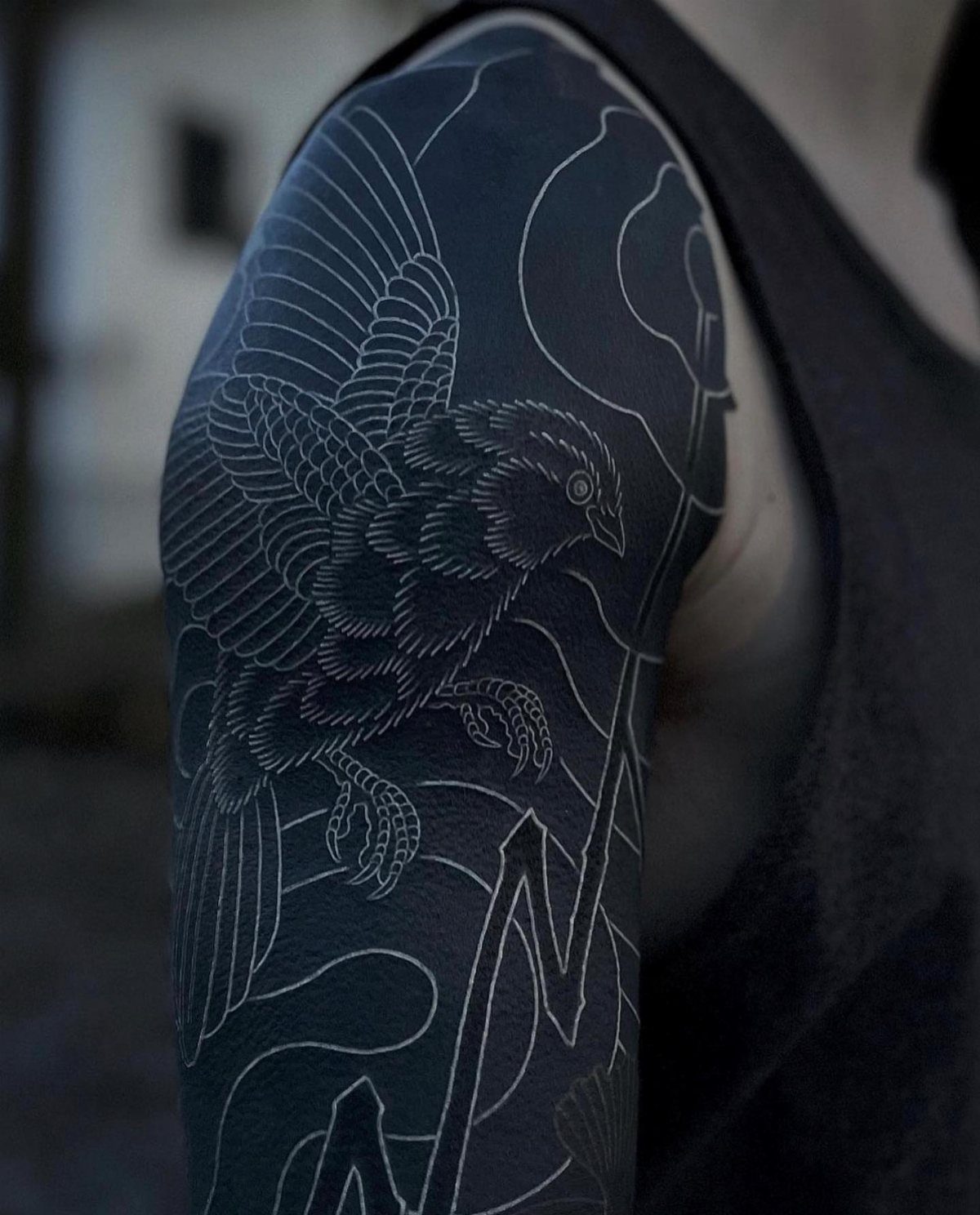
White ink over solid black reverses how tattooing normally works, and the result glows like chalk on slate. Fine white linework can pick out feathers, beak, eye, all the detail that blackwork usually draws in dark against light.
This needs a healed black base first, never fresh ink.
White sits on top of settled black, and even then it fades toward ivory or yellows slightly as the years pass. Touch-ups keep it bright, so plan for maintenance.
The effect suits a single focal image rather than scattered accents; one strong shape carries the inversion better than many small ones. A forearm or upper arm gives enough flat black field for the white to register clearly.


8. Solid Blackout with Hand Detailing
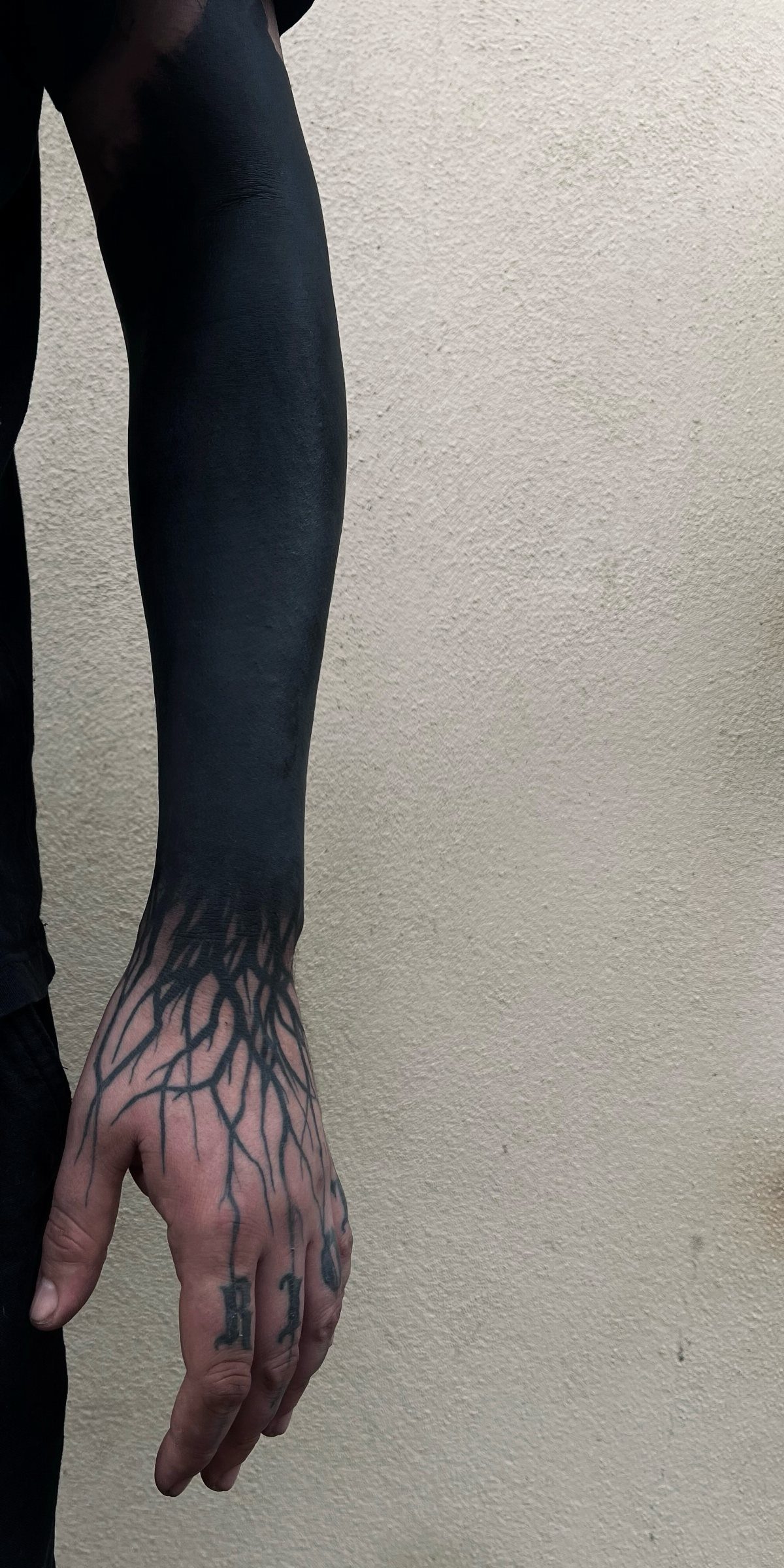
A forearm drowned in pure black that thins into root lines across the hand reads like something growing out from under the skin.
The blackout itself is straightforward: sessions of heavy fill, healing dark, building to total coverage. The hand is where the decision lives.
Finger and hand skin sheds and regenerates fast; linework there blurs sooner than almost anywhere else. Roots and other fine details are already a compromise against a blackout block, finer than the forearm field, accepting that they will soften.
Some artists won’t tattoo hands at all, others specialize in it. Finding one who does both blackout and hand work matters, since the two techniques need different needles and pressure.
Plan for the blackout to take multiple sessions, and for the hand to need refreshing within a few years.

MADE IN THE USA SINCE 1990: For over 30 years Dynamic Color has produced professional tattoo ink in the United States, an established American brand artists built their work on long before most imported labels existed.

COMFORTABLE - NO SLIP GRIPPER - NO ITCHY TAGS - NO CHAFE SEAMS -- Our no-slip gripper at the top of each tattoo cover sleeve keeps them firmly in place all day long.

American Made Quality - Proudly made in the USA with premium craftsmanship delivering high-quality protection and durability. Black full arm sleeves in MediuMLarge size for reliable coverage.
9. Biomechanical Blackwork Sleeve
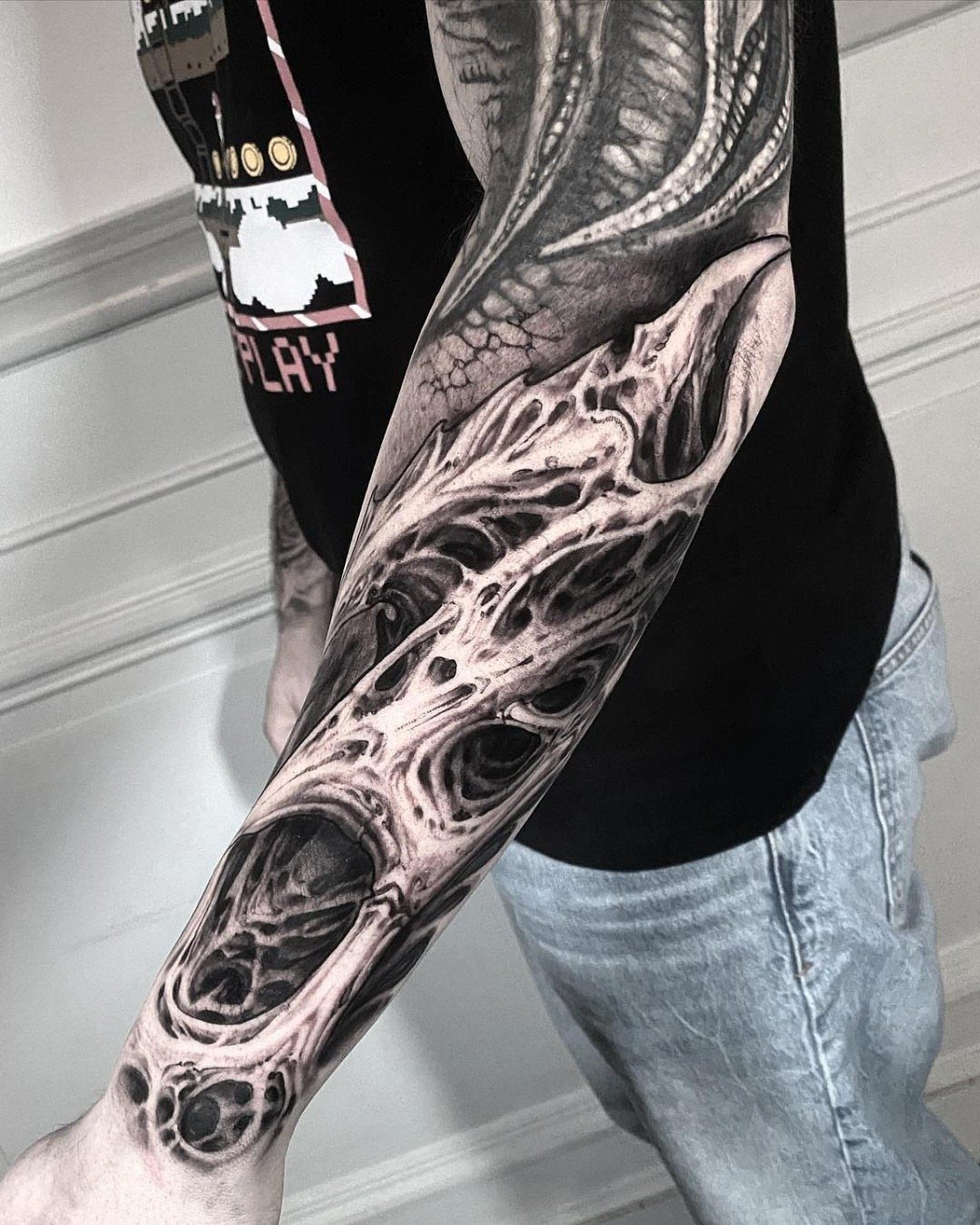
Machine parts rendered as flesh, or flesh becoming machine, gains its depth from black ink packed against bare skin tone rather than gray wash.
Dense black fills pistons, cables, bone plates across a full sleeve, letting the body’s own color read as metal sheen or exposed tissue.
A sleeve this complex needs the arm held steady through long sessions; the biomechanical style depends on precise perspective and flowing lines that follow the limb’s musculature.
Twisting the arm wrong during healing can distort the mechanical illusion, so sleeping on your back with the arm flat and uncovered helps protect the work.
This style suits someone with patience for the process and a taste for imagery that ages into darker, more unified tones as the black settles. The initial detail is vivid; the long view is mood and silhouette.


Choosing the Right Artist
An artist’s portfolio tells you everything if you know what to look for.
I flip straight to their blackwork pieces and check whether the lines stay consistent across large fills, whether solid black sits even without patchiness, whether geometric work holds its symmetry at scale.
Anyone can fill a small shape; a sleeve or back piece is where skill shows.
Pattern-making matters as much as line quality.
Blackwork builds shapes from repetition, and an artist who understands spacing, tension, and how a motif flows around a limb saves you from a design that looks right on paper and wrong on skin.
Ask how they plan to adapt a flat drawing to your specific body; the answer should involve measuring, stenciling, and probably adjusting the design on the spot.
Shading in blackwork is not gray wash.
It is dot density, line weight, skin breaks, the pressure of the hand. A portfolio with only flat black and no variation in texture means an artist who has not pushed past the basics yet.


Caring for Your Blackwork Tattoo
Aftercare for blackwork is not complicated, but the scale of these pieces makes slippage costly.
A palm-sized tattoo can scab and still heal readable; a solid black forearm or thigh that cracks or gets infected loses smoothness across an area too large to touch up evenly.
I keep the wrap on for the time the artist specifies, usually a few hours to overnight.
Washing starts after that: lukewarm water, fragrance-free soap, pat dry with something clean. No soaking, no gym sweat pooling in the wrap, no picking at scabs across a blackout that spans your whole forearm.
The temptation to peel a large dark area is stronger than with small color work; the scabs are bigger, the itch more relentless.
Moisturizing matters more with dense black fill than with linework. Dry skin on a solid field heals patchy, and patchy black reads as permanent unevenness.
I use a thin layer, not a glob, and stop when the skin quits drinking it in. Sun protection starts once the surface seals; fresh blackwork under UV turns ashy faster than almost any other style.
Longevity of Blackwork Tattoos
Black ink holds its ground against time better than most colors, but "better" is not "immune."
The contrast that makes blackwork striking on day one is the same contrast that shows fading first: solid black against bare skin, and the black is what lightens.
Sun is the enemy here, more than age itself.
UV breaks down the carbon-based pigment over years, and a blackwork sleeve or thigh piece that sees regular unprotected sun will gray out unevenly, the exposed surfaces faster than the hidden ones.
I plan coverage for anything I want to keep crisp: clothing, or SPF 30 and reapplication on schedule if the skin is showing.
Touch-ups are normal, not a failure. A refresh session on a large blackwork piece keeps it reading as intended, and planning for that maintenance beats pretending the ink is permanent in some absolute sense.
Frequently Asked Questions
How big is a $3,000 tattoo?
A blackwork tattoo at that price covers a substantial area: a full sleeve, a large thigh piece from hip to knee, or a full back panel.
The price reflects not just size but session count; dense geometric or illustrative blackwork at that scale needs multiple sittings, and artists billing hourly need serious time to keep lines crisp across that much skin.
What themes work best for a blackwork tattoo?
Geometric patterns, sacred shapes, and nature-derived imagery thrive in blackwork because the style builds everything from pure black ink against bare skin.
The high contrast suits anything that reads in silhouette: mandalas, florals, animals, celestial scenes, even biomechanical parts. What unifies them is that the design holds its shape without color gradation; the black itself carries the whole image.