Woodcut tattoos range from a single botanical branch to a full back piece of a wooden ship or medieval knight demanding multiple sessions, so the deciding factor is how much skin and patience you are actually working with.
The style’s carved texture comes from hatching and cross-hatching that builds shadow without soft shading, which means the artist needs steady command of parallel lines and you need to trust the roughness that reads as hewn rather than polished.
A winged eye from a 16th-century prayer book page or a knight pierced with arrows beneath a sunburst: the historical archive is deep, but only your available canvas and session budget determine which plate you pull from.
1. Religious Iconography Prints Tattoo
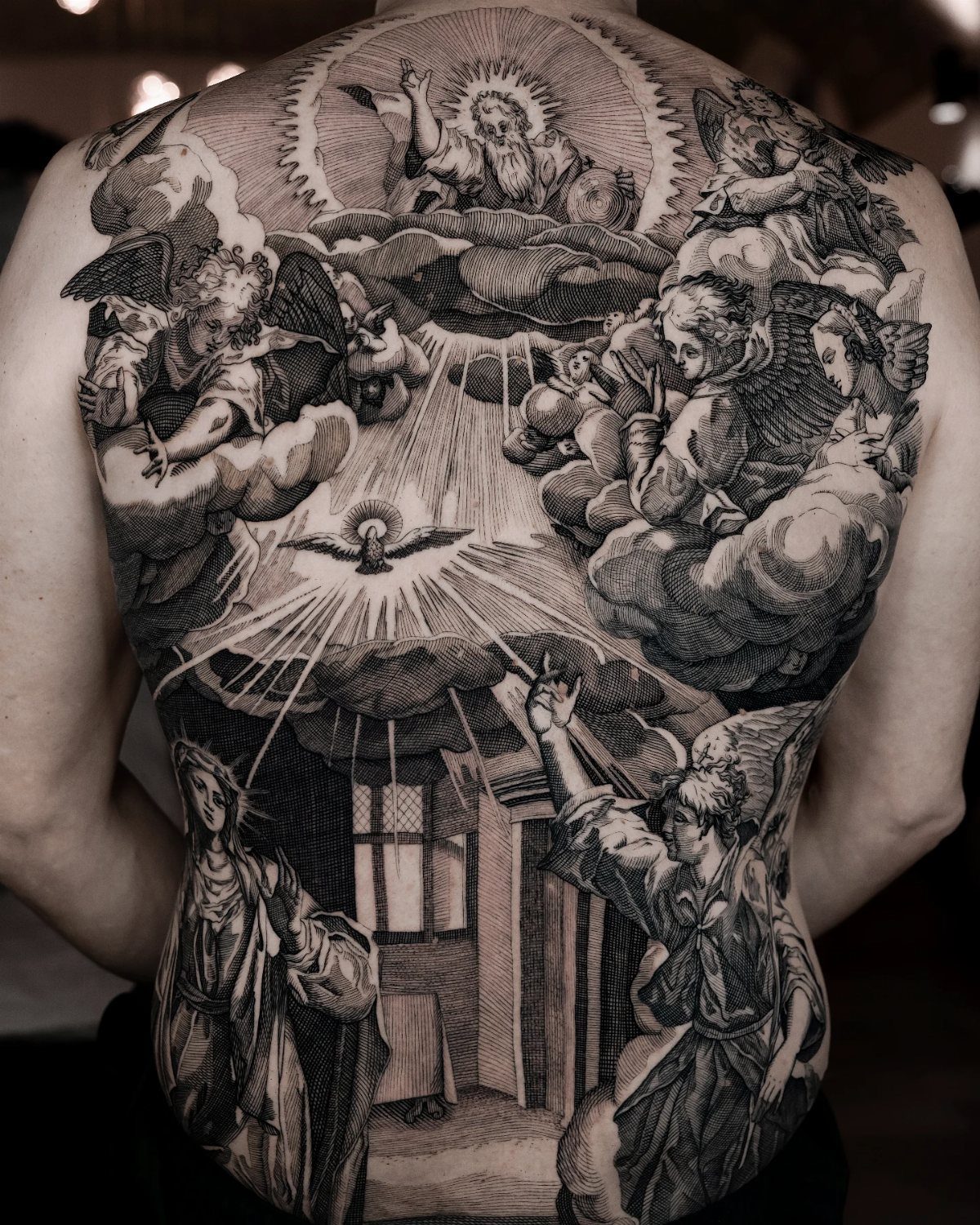
A full back piece in this style reads like a single page torn from a 16th-century prayer book.
The Annunciation, the Last Judgment, or a tiered heaven crowded with saints and devils: the engraving style handles dense narrative because every line carries weight and the black ink holds for decades.
German masters like Schongauer and Dürer left thousands of prints to pull from.
Picture dictionaries and devotional manuals add stranger fare: archers, impaled hands, bats with human faces, flames rendered as repeating curls. The style rewards a collector who wants meaning stacked thick enough to study for years.
A piece this dense takes longer in the chair than a softer style, and the bill reflects that.
A back this detailed takes multiple sessions, and the artist needs steady command of parallel hatching. If your patience matches your skin space, religious iconography in woodcut style delivers permanence with pedigree.


2. Medieval Woodcut Tattoo of Knights
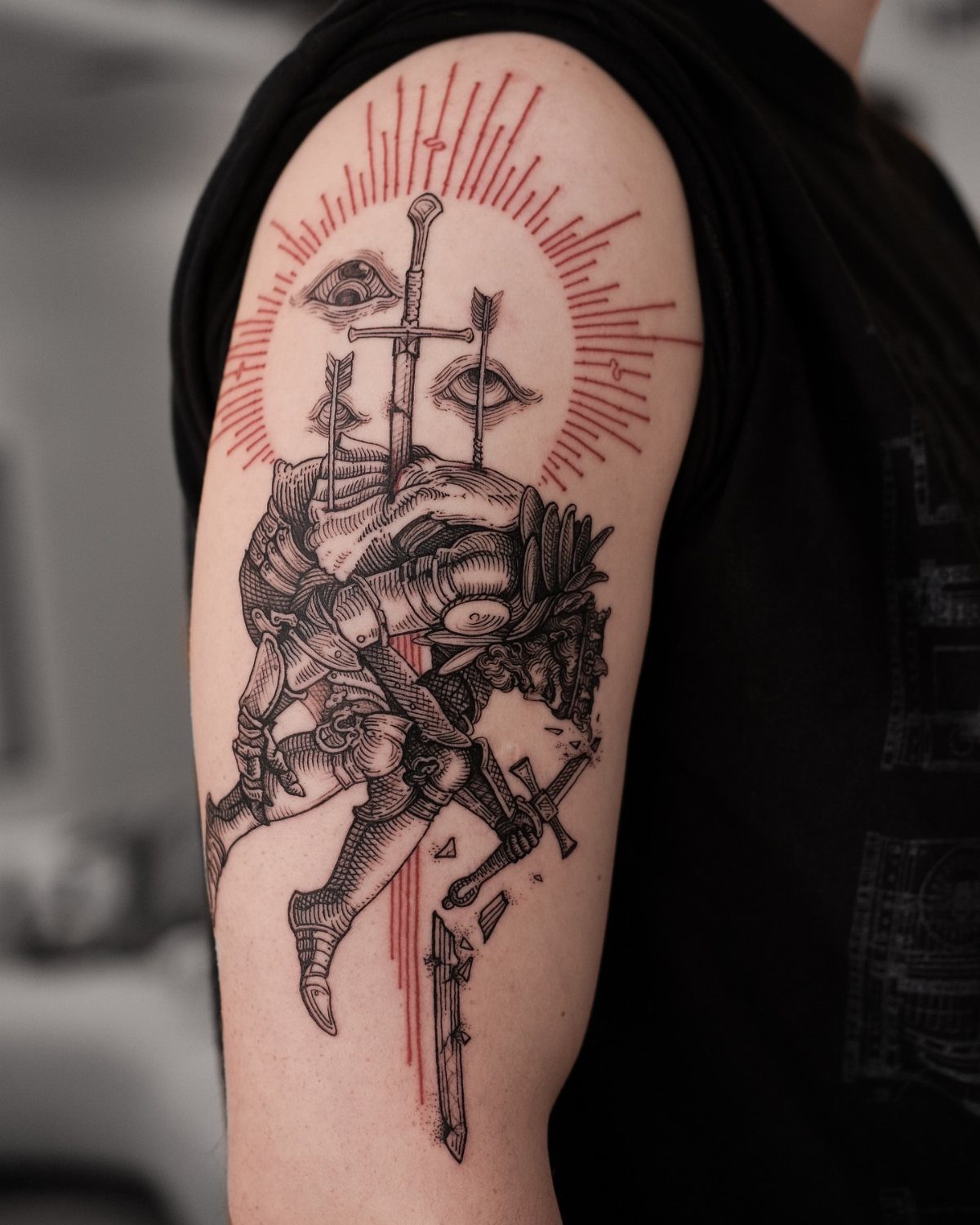
Knights in woodcut style carry a particular brutality: not the polished armor of film, but the raw, almost folk-carved figures of 13th- to 16th-century block prints.
A wounded knight pierced with arrows beneath watching eyes and a sunburst hits that register exactly.
The graphic power comes from deliberate roughness.
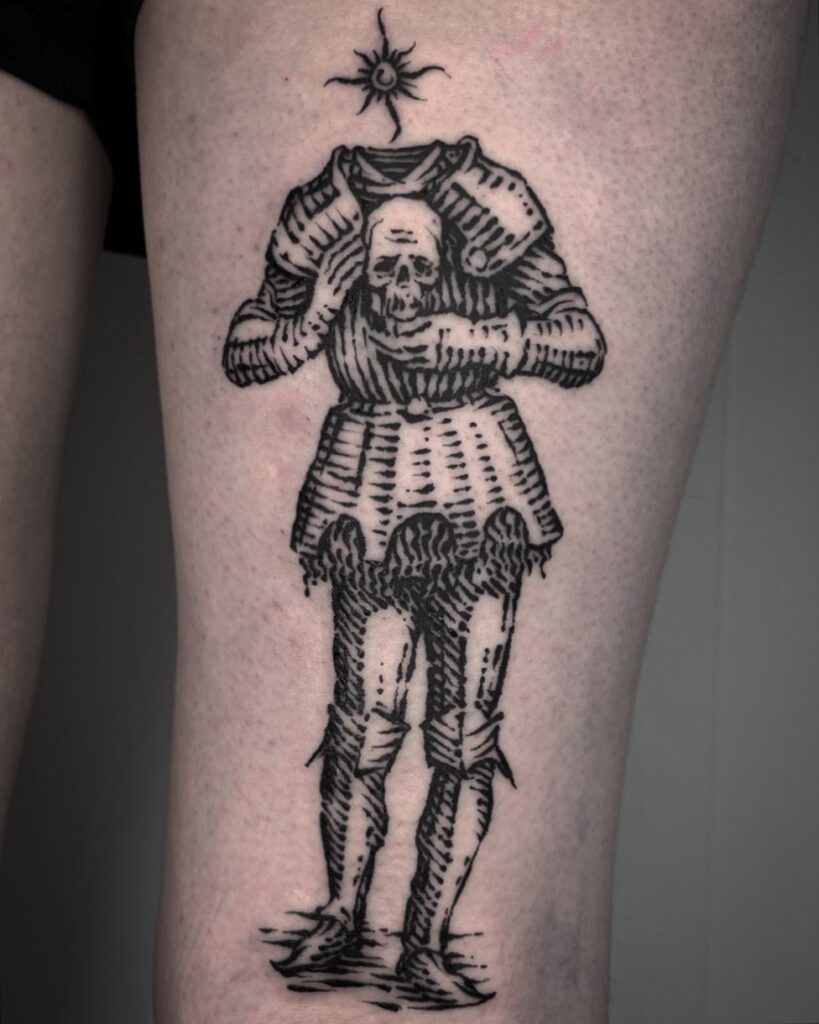
Imperfect lines, uneven hatching, and the visible hand of the carver are features, not flaws. Heraldic beasts, memento mori skulls, and grotesque monsters share this same visual DNA.
This suits someone who wants medieval atmosphere without fantasy slickness.
Ask your artist about line weight: too fine and the rough quality disappears; too bold and it becomes cartoon. The best lines look carved with a knife that was not quite sharp enough.

Dopetattoo Waterproof High-Quality Easy-Use Long-Lasting Temporary Tattoos.You can take it to the beach, swimming pool, bath and any other water activities. Without excessive friction. It will last 3-5 days.

Realistic Finish: Different from you know ordinary temporary tattoo stickers or fake tattoos. It is so real and comparable to the real tattoo. It is a semi-permanent technology, Water-Resistant, friction-resistant, and can last for a long time, staying on your skin for 1-2 weeks.

Realistic Finish: Different from you know ordinary temporary tattoo stickers or fake tattoos. It is so real and comparable to the real tattoo. It is a semi-permanent technology, Water-Resistant, friction-resistant, and can last for a long time, staying on your skin for 1-2 weeks.
3. Wooden Ships
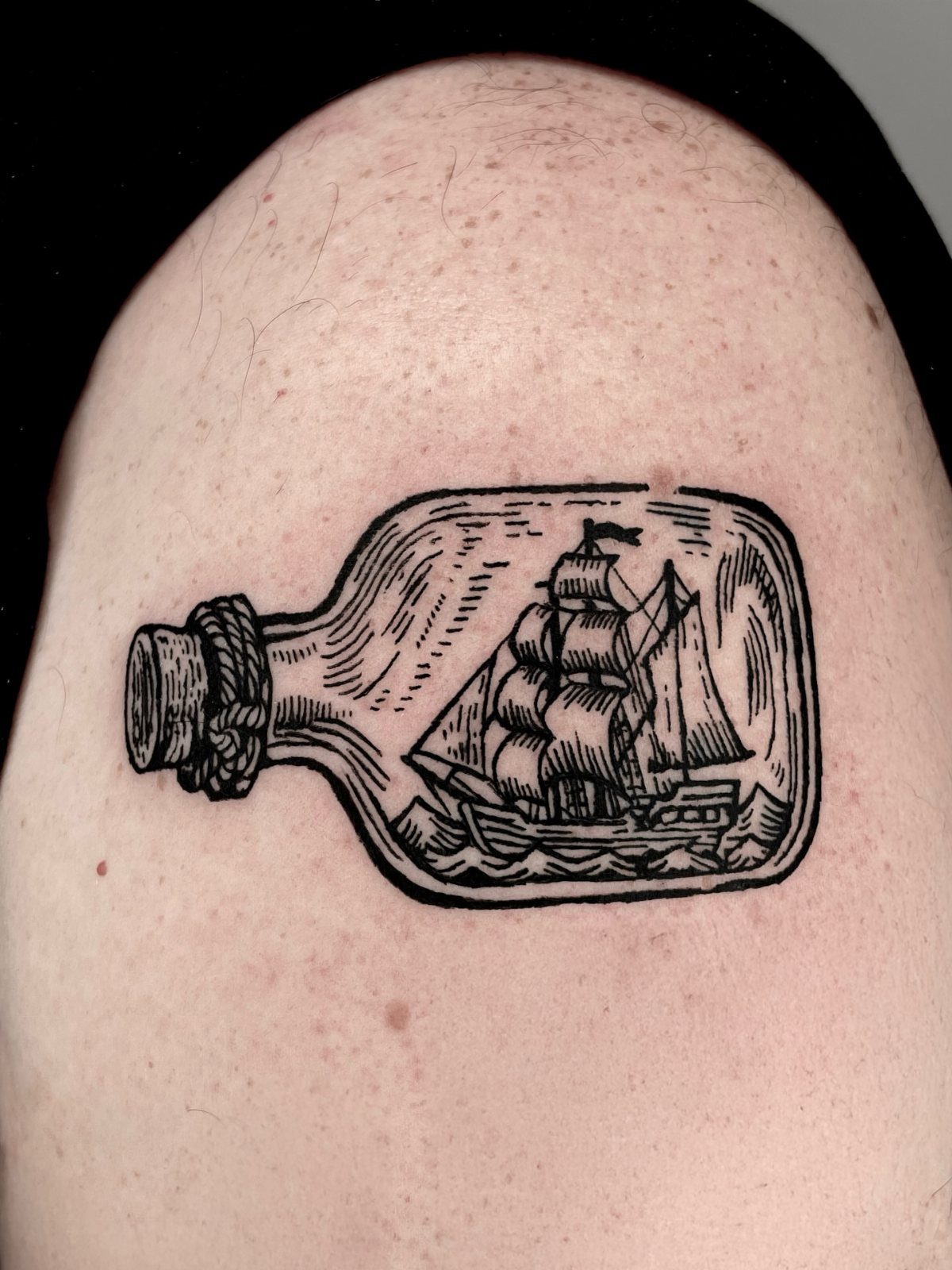
A ship inside a bottle is already a nested metaphor: the journey contained, the adventure deferred, the sea domesticated.
In woodcut style, the rope lashing, the cork stopper, and the plank lines of the hull all gain the texture of scrimshaw or a whaler’s journal illustration.
The line work carries the whole piece.
Shadow builds from parallel cuts rather than soft shading, so the sails read as full or furled depending on hatching direction. Water can stay implied, a few wave curls at the bottle’s base, or open white around the hull.
Sailor art from the 17th through 19th centuries offers a deep archive of ship poses and rigging details to adapt.
The style pairs naturally with themes of love and loss, distance and return. For placement, the cylindrical bottle shape wraps well on forearms and calves without distorting.
4. Landscape Tattoos
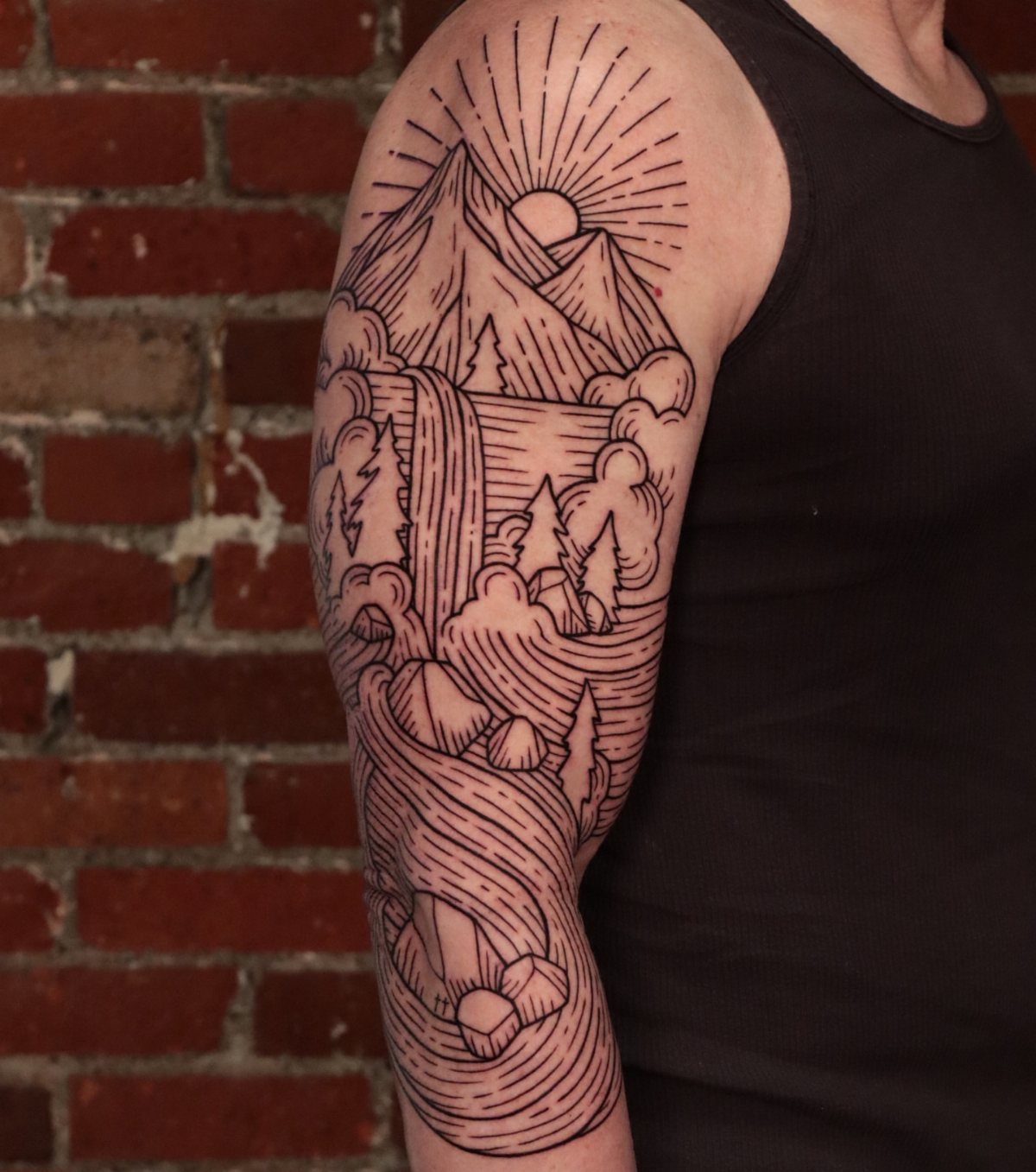
Woodcut landscape trades photorealism for something more durable on skin.
Mountains, waterfalls, and trees reduce to their essential lines: ridge lines become parallel strokes, water falls as white channels between black rock, and the sun rises as a blank circle or a field of radiating cuts.
Negative space does the heavy lifting. The skin itself becomes sky, snow, or still water, which keeps the tattoo readable as it ages and spreads.
A sleeve built this way can read as panoramic or as separate scenes, depending on how the artist links the black masses.
This approach suits someone who wants nature on their body without the maintenance demands of heavy color saturation. The style also accommodates personal geography: your home range rendered in the vocabulary of a 19th-century naturalist’s field guide.


5. Woodcut Style Insects and Animals
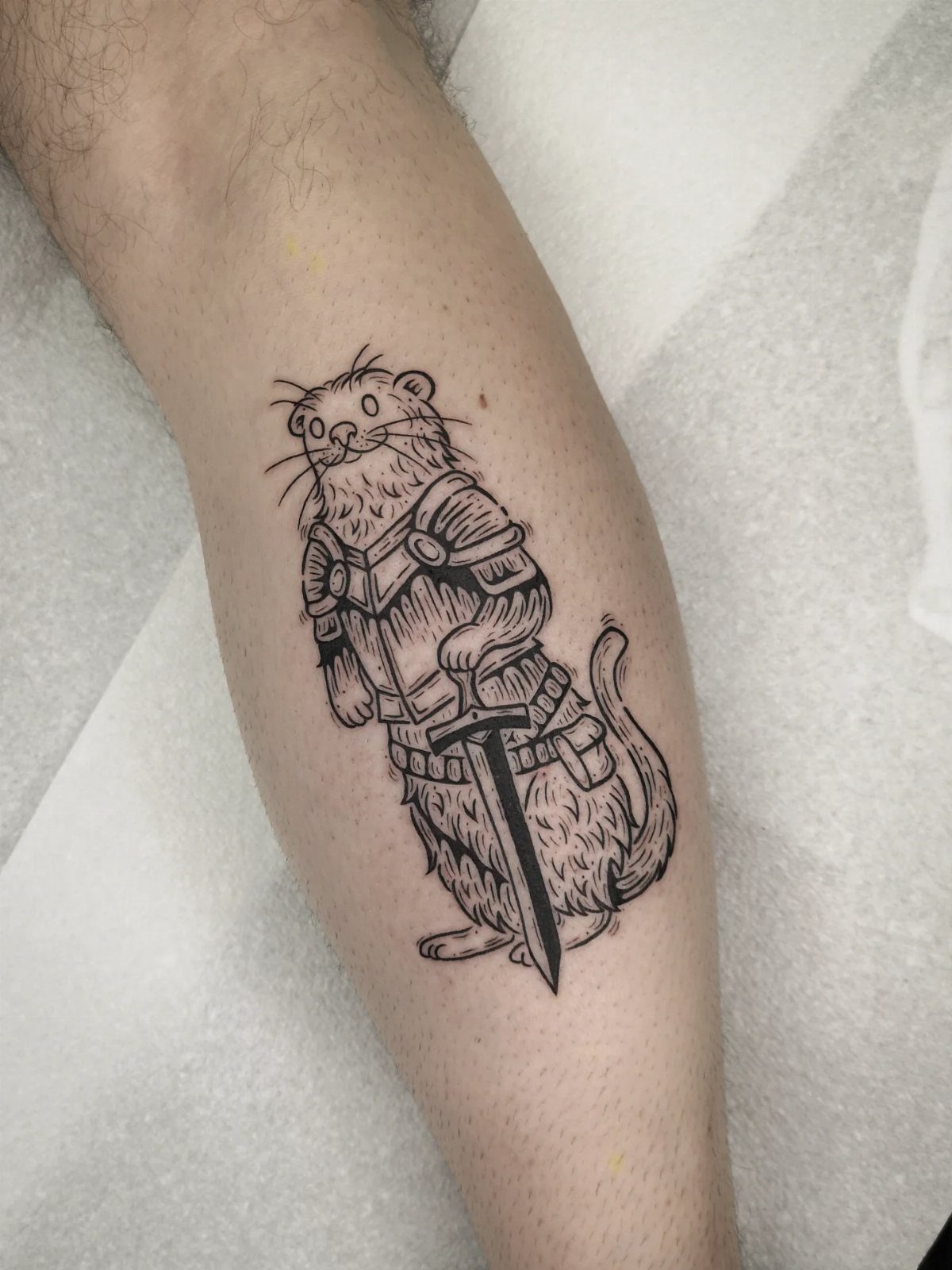
An armored otter with a sword is ridiculous and majestic in the proportion only medieval bestiaries achieved.
Woodcut style makes the joke land because the technique itself is serious: every plate line, every joint in the armor, every whisker rendered with the same gravity as a saint in a missal.
Animals and insects translate well because the style’s carved texture mimics fur, shell, and wing case naturally.
A beetle’s elytra become parallel hatch marks; an otter’s fur, directional strokes that follow the body. The anthropomorphic twist, dressing the creature in human role, comes straight from medieval precedent.
For your own version, pick an animal with personal weight and a role that amplifies or contradicts its nature.
The contrast drives the piece. Line density matters more than size: a small tattoo with packed hatching holds detail better than a large one with sparse lines.
6. Medieval Dragon Tattoo
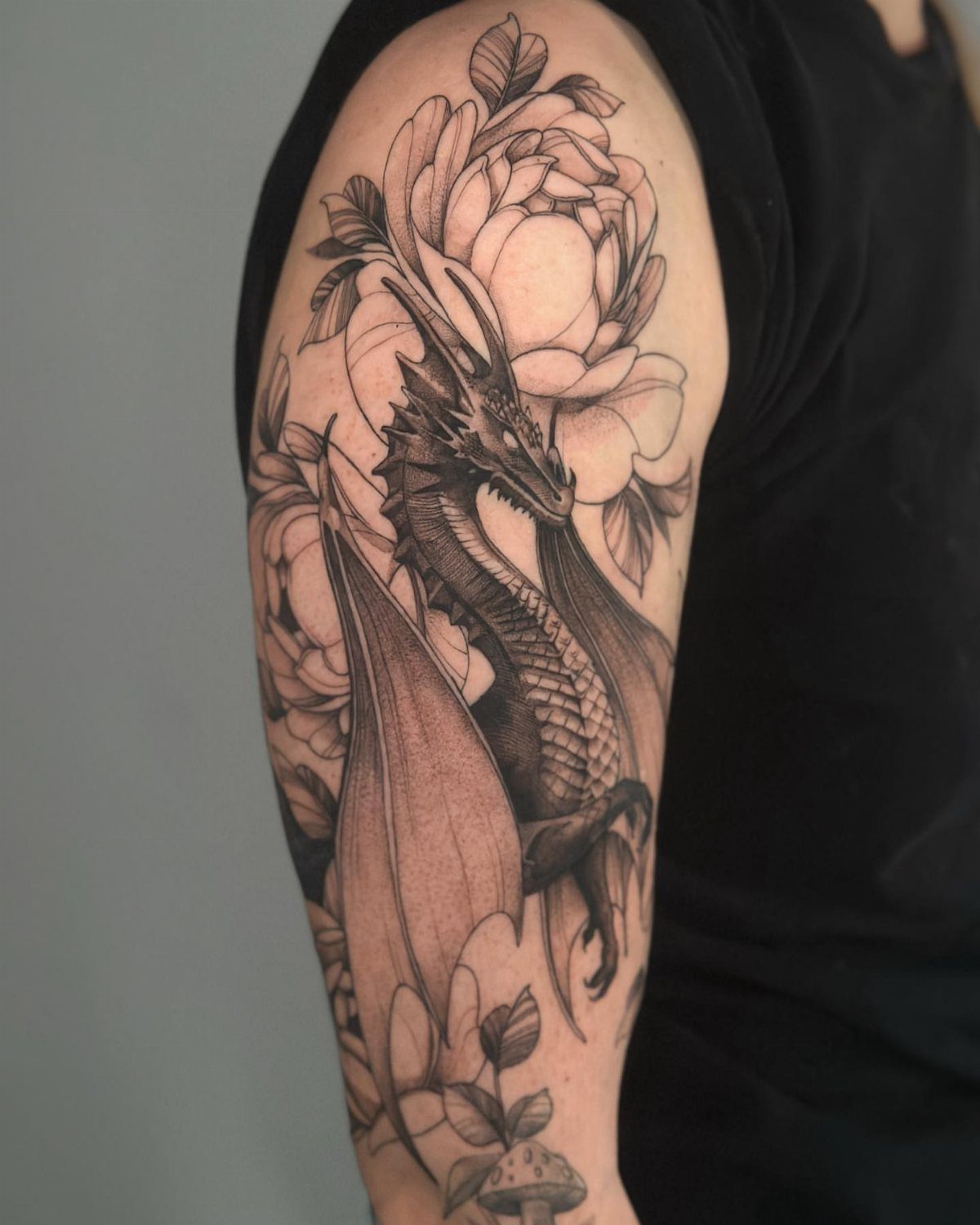
Medieval dragons were stranger than the smooth fantasy versions we grew up with: part reptile, part bird, all sharp angles and heraldic posture, with dense hatching that hints at scale without spelling it out.
A woodcut dragon carries that alien quality forward.
The example pairs the creature with peony blossoms, a combination that softens the menace without weakening it.
The flowers give the eye resting places between the wing bones and the serpentine neck. Hatching direction separates textures: scales read one way, petals another, and the wing membrane a third.
This suits readers drawn to mythological weight but bored by standardized fantasy iconography.
The medieval form reads as historical artifact rather than pop culture reference. For longevity, space the hatching wide enough that a little spread over years still reads as texture, not a solid blur.
The dragon’s eye, typically a blank oval or a single drilled point, is the detail to get right: everything else follows its register.
7. Winged Eye Tattoo
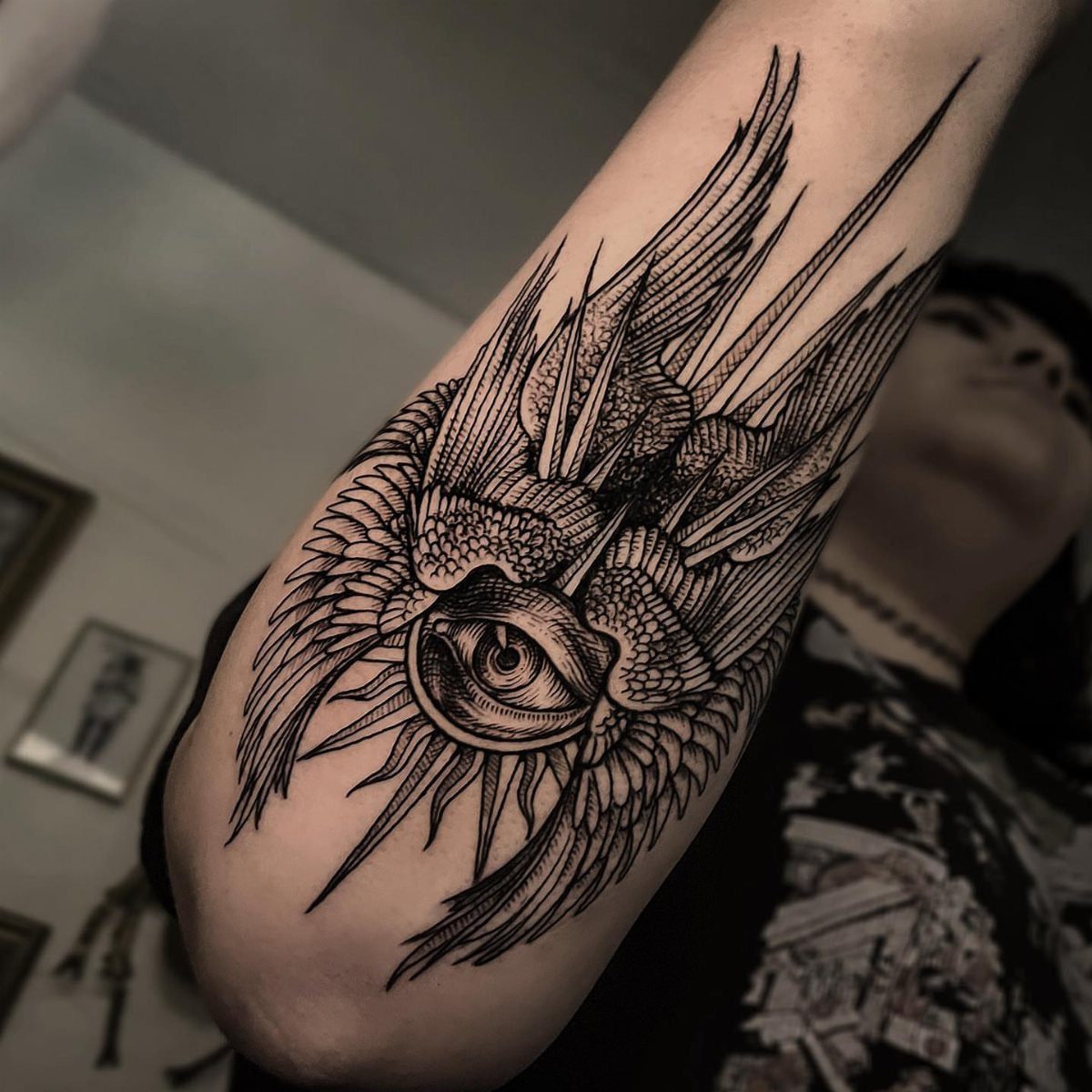
The winged eye carries a specific charge: sight made mobile, perception given flight. In woodcut style, the feather barbs read as engraved parallel strokes, and the eye’s iris gains depth from concentric hatching rather than soft modeling.
This symbol has served vigilance, providence, and punk rock with equal ease, so the meaning you attach matters more than any fixed reading. Placement on the inner arm keeps it personal, visible to you on demand without broadcasting.
Ask your artist about the wing spread relative to your arm width; too wide and the feathers distort when the muscle flexes.
The radiating lines around the eye need room to breathe, so scale down the detail before you scale down the size.


8. Sword and Banner Tattoo
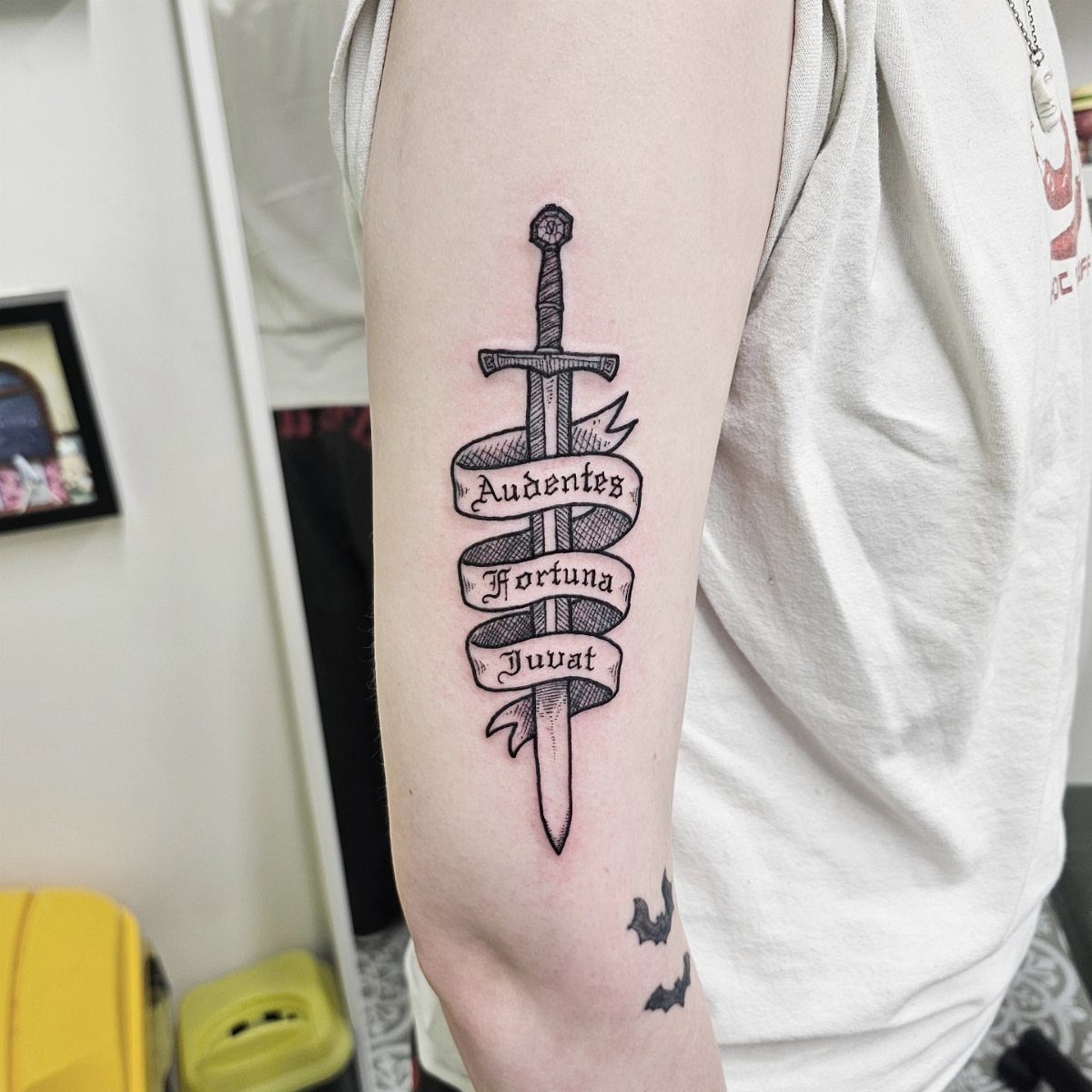
A sword and banner in woodcut style reads like a printer’s mark or a guild sign: functional, declarative, made to be read at distance. The Latin inscription, "Audentes Fortuna Juvat" (fortune favors the bold), turns personal motto into public statement.
The vertical format suits the upper arm’s cylinder, with the blade following the bone and the banner wrapping naturally. 2 small bats below fill space without competing; their silhouette shape keeps the hierarchy clear.
Line weight is the decision that makes or breaks this piece. The sword edge needs crisp definition against the banner’s folds, and the lettering must stay legible after healing.
Choose a serif or blackletter typeface with stroke contrast that matches the woodcut vocabulary; a thin modern sans-serif will look like an error once the surrounding ink ages.
9. Woodcut Bird Skull Tattoo
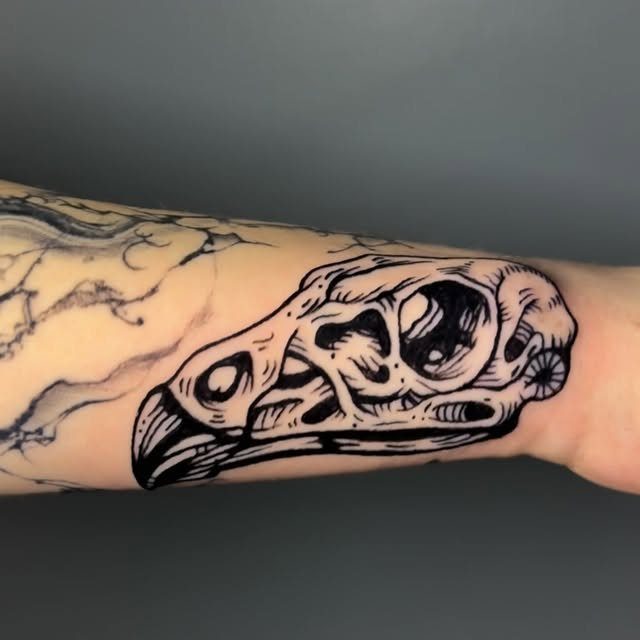
A bird skull in this style strips sentiment from the memento mori tradition and leaves structure: the hollow orbit, the fused beak, the delicate struts that once held feather and muscle.
The dark grey background sets the bone forward the way a 17th-century anatomical plate isolates its specimen.
Hatching direction does the work of volume. Cross-hatched shadows under the skull’s curve lift it from flat; longitudinal strokes along the beak emphasize its length.
The background tone needs to stay uniform, which means either solid black fill or consistent grey wash, never both in the same piece.
This suits someone who wants skull imagery without the usual biker or Halloween associations. The bird form reads as natural history, closer to Audubon than to heavy metal.
For longevity, the eye socket’s black must go deep enough that touch-ups do not show as rings; ask to see healed examples of solid black in your artist’s portfolio.
10. Botanical and Ornamental Branch Tattoo
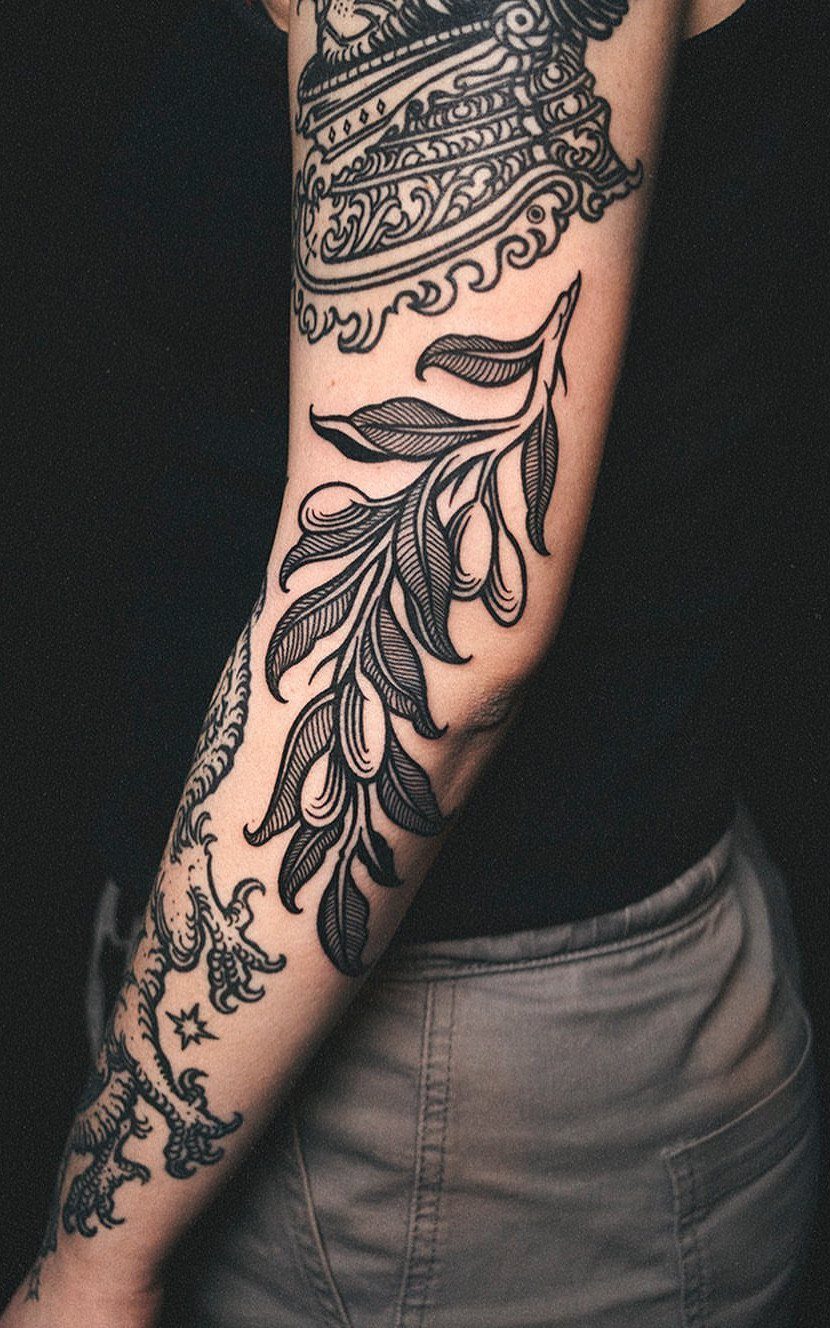
Leafy branches in woodcut style let the skin itself become page, the black ink forming figure against ground the way a block print leaves paper bare for light.
Ornamental scrollwork paired with a small creature reads like a bound volume on the arm, each band carrying its own plate.
Botanical subjects suit this style because growth patterns already follow line: veins, stems, the alternate spacing of leaves.
The artist translates those into carved strokes, and the result reads as both specimen and decoration. Dark background shading behind the branch pushes the foliage forward and lets the negative space read as sky or page.
This approach rewards the collector building over time. The sleeve format accommodates new chapters: more flora, heraldic beasts, architectural frames.
Each addition matches if the line weight and hatching density hold steady. Start with the inner forearm branch if you are testing the style; it stands alone while leaving room to extend toward wrist and elbow.
Techniques Used in Woodcut Tattoos
Hatching, cross-hatching, and stippling build depth in woodcut tattoos without the solid fills you see in black and grey work.
The dimension comes from half-tones, subtle shifts between line densities that read as shadow rather than volume. Clean outlines carry the image; the interior techniques serve only to lift forms off the flat plane.
An artist working this style keeps line weight deliberate and consistent. Too much variation breaks the print illusion; too little flattens the piece into a mere outline drawing.
Ask to see healed photos where stippling has aged: dots tend to spread more than lines, and a dense field can blur into unintended grey.
The roughness that reads as hewn in a fresh tattoo still needs technical control.
Uneven lines should look carved, not shaky. A practiced hand makes the accidents intentional.
The woodcut style translates particularly well into tattoo design. Often using one colour (the best one – black) the designs contrast against even the darkest of skin tones, making the piece pop.
Historical Context of Woodcut Tattoos
Woodcut printing on textiles in China dates back centuries before the technique migrated to paper.
It reached Europe by the 13th century and peaked as a print medium in the 15th and 16th centuries, the period most woodcut tattoos reference today.
That European moment matters for the imagery. Religious broadsides, bestiaries, anatomical texts, and printers’ marks from 1400–1600 supply the visual vocabulary: the bold outlines, the stark black-and-white contrast, the simplified forms that read at small scale.
Medieval and early modern woodblock printing also carried an inherent roughness from the carving process; the knife slips, the grain raises, the ink sits unevenly. Woodcut tattoos inherit this texture as aesthetic rather than flaw.
The style’s current popularity in tattooing traces partly to this specific historical anchor. It reads as artifact rather than invention, which suits collectors who want their skin to carry weight beyond the moment of application.
Placement Suggestions for Woodcut Tattoos
Forearm, upper arm, back, chest, thigh, and sleeve all accommodate woodcut work, though each location demands different planning.
The forearm’s flat, accessible surface suits the fine etching and cross-hatching that woodcut tattoos rely on.
Detail stays readable there, and the area heals relatively predictably. The upper arm gives you room for a bigger design without signing up for the months a back piece takes.
The back is where ambitious woodcut work goes to breathe. A full back piece in this style is among the most demanding projects in tattooing, both for the artist’s endurance and the collector’s sessions.
Chest placement works well for symmetrical medieval imagery, heraldic designs, or anything that wants a central axis. The sternum provides natural focal point.
Thighs offer large canvas with easier concealment than back or arm. Sleeves can build continuous narrative, though woodcut’s dense black masses require careful planning around the elbow’s distortion.
Hatching direction shifts when your muscles flex, so ask your artist how those lines will read when you move. Lines that align with flexion age cleaner; lines across it can blur unevenly as skin shifts over years.
Frequently Asked Questions
What is a woodcut style tattoo?
A woodcut style tattoo replicates the visual language of historical woodblock printing: bold, uneven outlines, strong black-and-white contrast, and an intentional roughness that looks carved rather than drawn.
The technique relies on hatching and cross-hatching to build shadow, with the skin left as negative space for light areas. Most designs pull from 15th- and 16th-century European sources: religious broadsides, bestiaries, anatomical plates, and printers’ marks.
What is the 1/3 rule tattoo?
The rule of thirds in tattooing places the focal point at an intersection of visual thirds so the eye moves naturally across the piece; a woodcut design centered dead on the forearm can look static, but the same piece offset to the outer third reads like a print pulled fresh from the block.