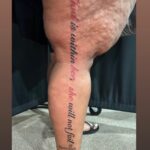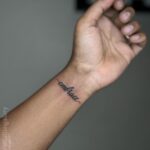
Rune tattoos range from a single finger glyph to a full blackout sleeve, and the deciding factor is how much skin you are willing to commit to a system that demands precision.
1. Bind Runes
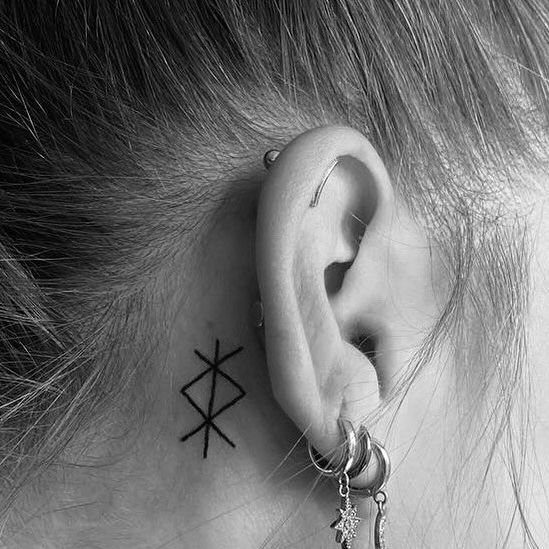
A bind rune is two or more runic characters overlapped or joined into a single glyph, the way a monogram compresses initials into one mark.
A bind rune tucked behind the ear hides under hair when you want it gone from view.
You choose which runes to bind based on what you need: love, luck, courage, health, energy.
A tattooist familiar with Elder Futhark can draft combinations that read correctly; a bind rune that only looks right to you but means nothing in the system is a common mistake I have seen in shop portfolios.
Keep the design simple. Overlapping more runes turns the design into a knot nobody can parse.

Package Content: You will receive 6 pieces of stencils for painting on wood, sufficient quantity and abundant patterns to satisfy your various crafting needs.

Theme Design Set: Includes 64 Viking runes and Norse symbol designs with runic marks, axes, helmets, moons, symbols, knots, and small mythology-inspired icons for coordinated stencil painting projects

Massive 56-Piece Runes & Celtic Pattern Set: This all-in-one kit includes 56 unique designs featuring Viking runes, Tree of Life, Celtic knots, and nature-inspired symbols. Perfect for wood burning, wall art, fabric painting, and DIY crafts.
2. Aegishjalmur Protection Symbols Tattoo
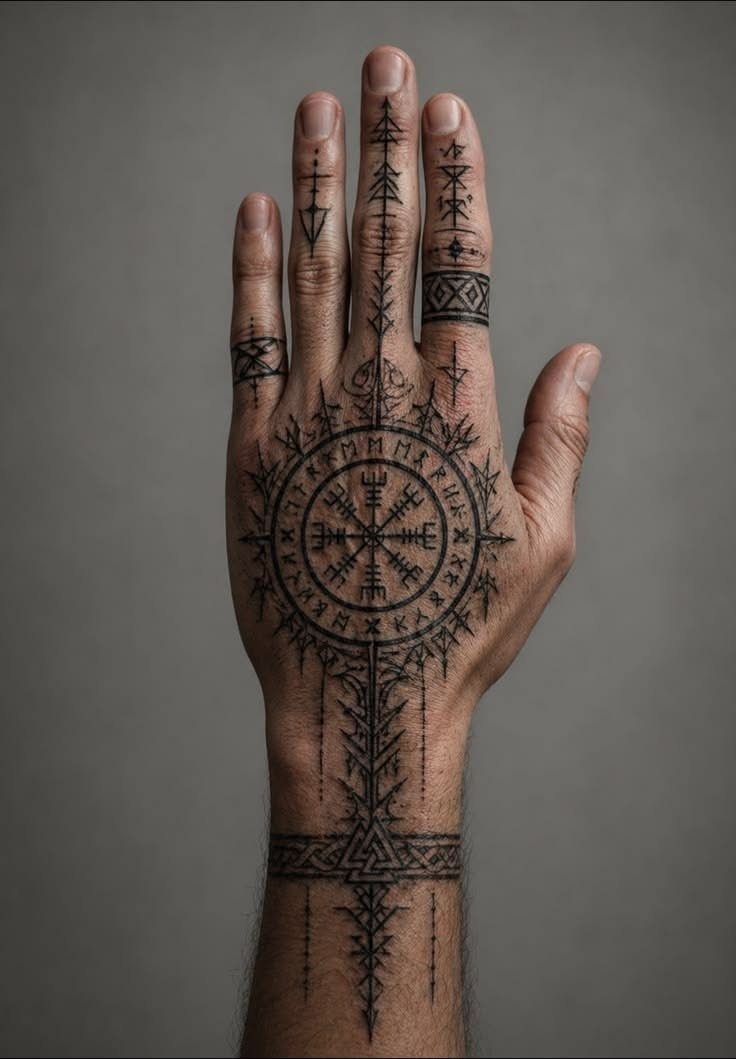
The Aegishjalmur, or Helm of Awe, is an Icelandic stave rather than a true rune, though tattoo shops file it under rune work because it shares the same visual territory.
Layering it with a runic circle and Valknut reads as spiritual armor stacked thick.
Algiz, the actual rune of protection, appears simpler: a single vertical with 2 upward branches, like a stick figure raising both arms. Some people choose Algiz for its cleaner line when a full Aegishjalmur would crowd the placement.
Either symbol works as a standalone or as the center of a larger composition. On the hand, the detail level needs to hold up against constant washing and sun; plan for touch-ups.

Innovative Skin-Sync Technology: We don't just sit on the skin; we interact with it. By reacting organically with naturally occurring proteins in your skin's outermost layer (stratum corneum), our plant-based formula magically transforms from a transparent guide into a rich, ultra-realistic navy-black. It looks exactly like a healed, permanent tattoo—without the needles or depth.

MADE IN THE USA SINCE 1990: For over 30 years Dynamic Color has produced professional tattoo ink in the United States, an established American brand artists built their work on long before most imported labels existed.

MADE IN THE USA SINCE 1990: For over 30 years Dynamic Color has produced professional tattoo ink in the United States, an established American brand artists built their work on long before most imported labels existed.
3. Vegvisir Compass
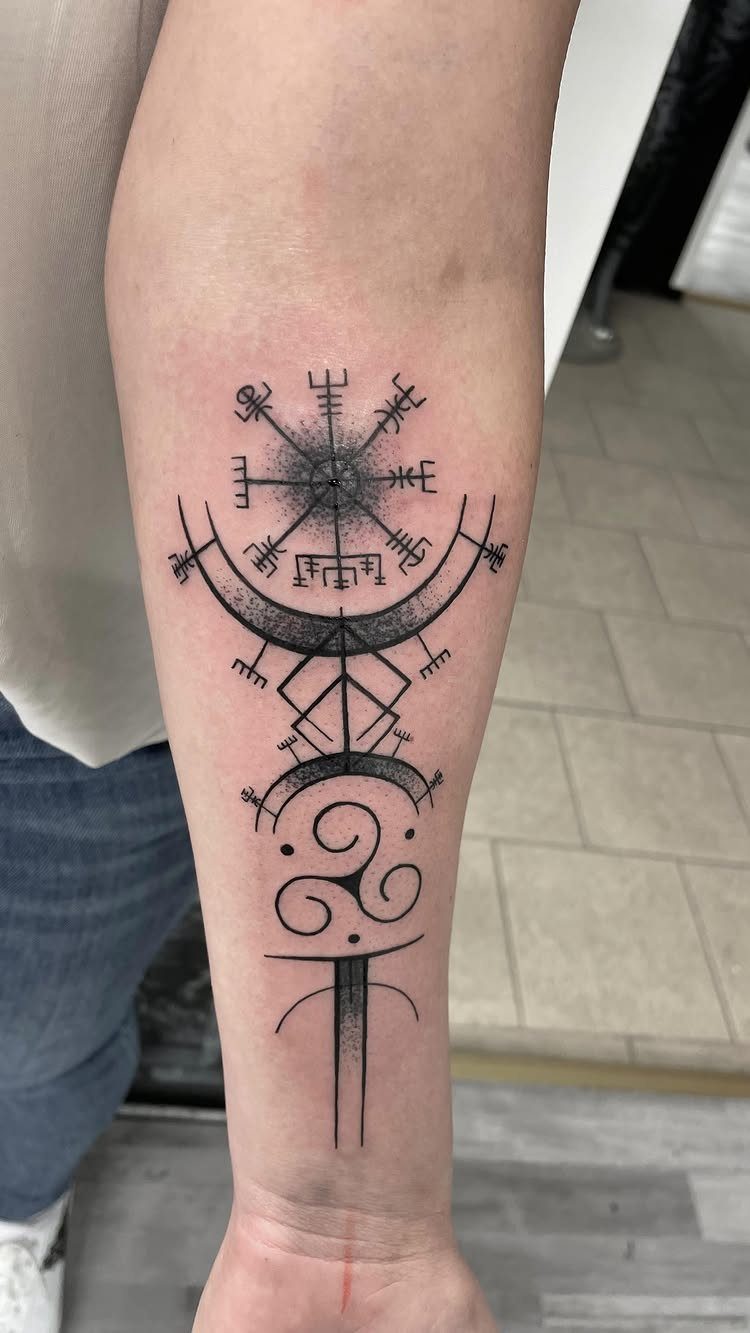
The Vegvisir is another Icelandic stave, not technically a rune, though it gets grouped with them because it incorporates runic-style lines and because Norse tattoo culture does not fuss much over the distinction.
Pairing it with a triskele and geometric framing keeps the symbol from floating alone on the skin.
This design suits someone who wants guidance symbolism without the warrior connotations that come with Aegishjalmur or Valknut.
The circular form works well on flat areas like the inner forearm, where the full compass can sit without wrapping awkwardly around a curve.
The radiating lines need precise spacing; a Vegvisir drawn freehand often ends up lopsided. Ask to see your artist’s stencil before the needle touches skin.

Innovative Skin-Sync Technology: We don't just sit on the skin; we interact with it. By reacting organically with naturally occurring proteins in your skin's outermost layer (stratum corneum), our plant-based formula magically transforms from a transparent guide into a rich, ultra-realistic navy-black. It looks exactly like a healed, permanent tattoo—without the needles or depth.

Unique Design Viking Temporary Tattoo: Yazhiji Vikings were not only super cool, but also a symbol of strength, passion, and determination, reflecting strength, bravery and courage, the image of the Viking attracts the attention of history buffs and body art enthusiasts alike.

Dopetattoo Waterproof High-Quality Easy-Use Long-Lasting Temporary Tattoos.You can take it to the beach, swimming pool, bath and any other water activities. Without excessive friction. It will last 3-5 days.
4. Celtic Knotwork
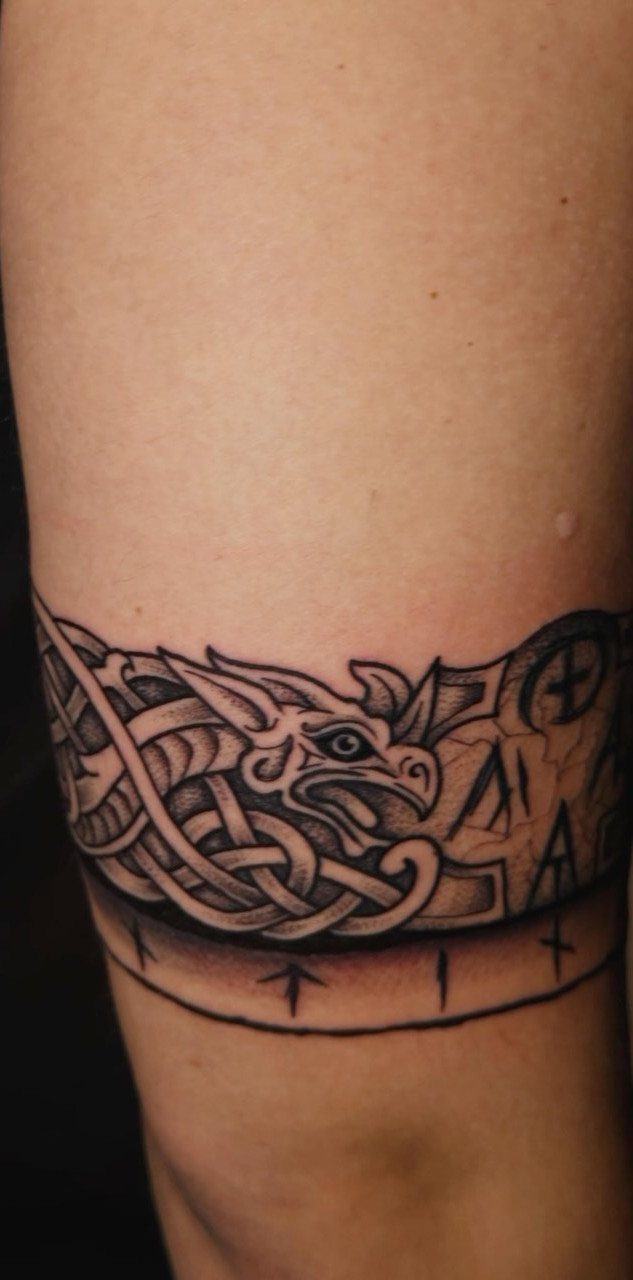
Celtic knotwork and Norse runes come from different cultures and different centuries, but tattooing has long treated them as cousins because both read as ancient European line work.
Shaping the knot into a beast form and studding it with runes solves the problem of either element looking pasted on.
The knotwork stands for interconnectedness and eternity; the runes add specific meaning you choose. A band like this works as an armband, a leg band, or wrapped around a wrist, though the detail level needs enough circumference to breathe.
Line weight matters. Too thin and the knots blur within a few years; too heavy and the beast shape loses its teeth.

Innovative Skin-Sync Technology: We don't just sit on the skin; we interact with it. By reacting organically with naturally occurring proteins in your skin's outermost layer (stratum corneum), our plant-based formula magically transforms from a transparent guide into a rich, ultra-realistic navy-black. It looks exactly like a healed, permanent tattoo—without the needles or depth.

Amazing Product: Different from you know ordinary temporary tattoo stickers or fake tattoos. It is so real and comparable to the real tattoo. It is a semi-permanent technology, waterproof, friction-resistant, and can last for a long time, staying on your skin for 1-2 weeks.

Amazing Product: Different from you know ordinary temporary tattoo stickers or fake tattoos. It is so real and comparable to the real tattoo. It is a semi-permanent technology, waterproof, friction-resistant, and can last for a long time, staying on your skin for 1-2 weeks.
5. Forearm Rune Tattoos
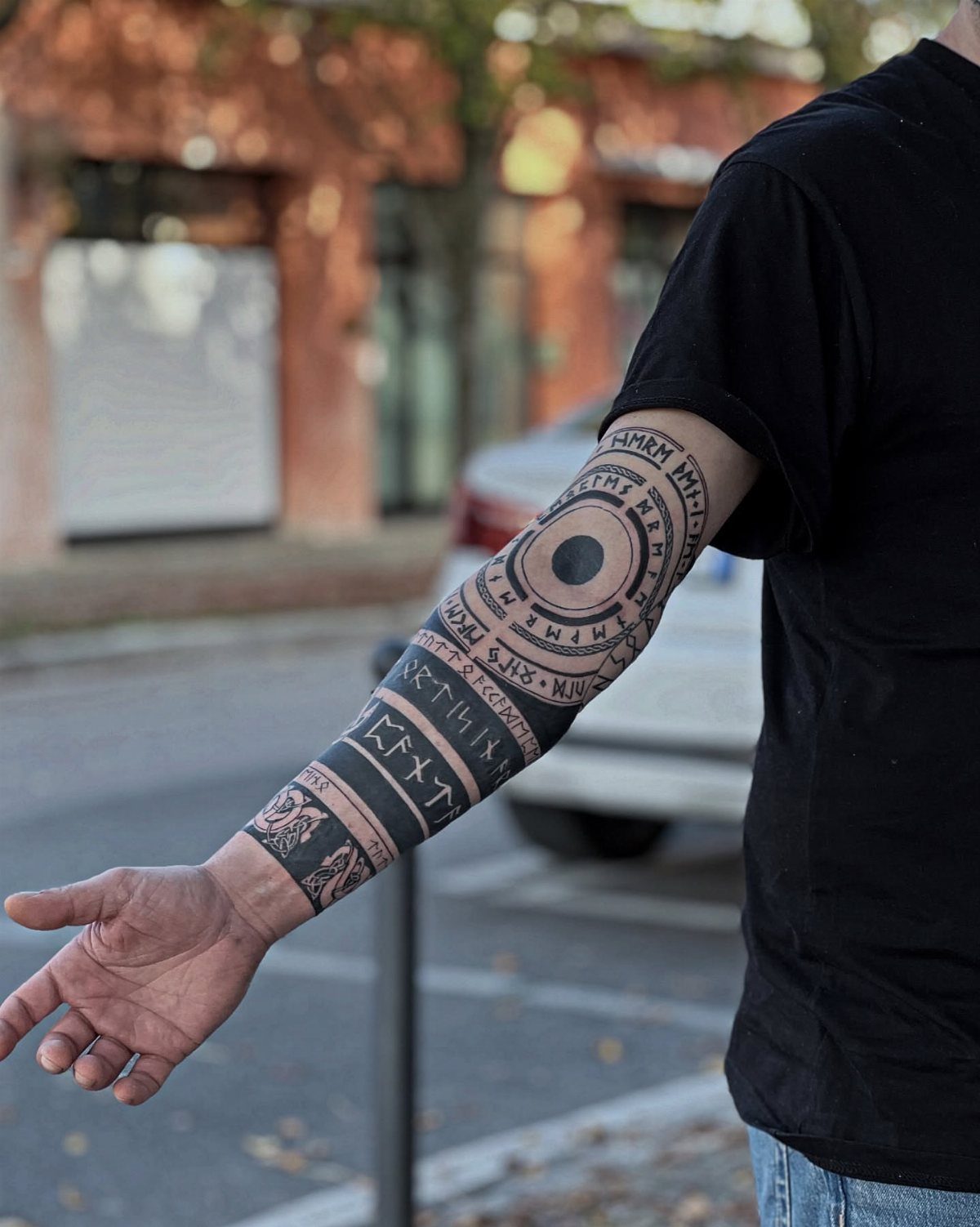
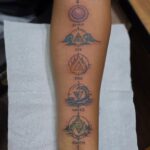
Forearm runes give you the easiest placement to show or cover: long sleeves hide them, short sleeves frame them. Circular patterns and geometric bands in blackwork read clearly from conversational distance without shouting.
Decide early whether you want the runes readable or decorative. Elder Futhark runes have set shapes; a tattooist who freehands them often inverts or misdraws one, and you will not know until someone who reads them points it out.
Bring a verified source image, not a Pinterest screenshot that may already be wrong.
The circular composition follows the forearm’s natural cylinder. Vertical or horizontal bands work too, but circles use the space without fighting the bone structure.

JUST AWESOME (We think so!) - You can't go wrong with a set of Sniggle Sloth premium stickers! Offering thousands of themed designs ranging from the unique to the truly bizarre, and everything in-between and then some.

Dopetattoo Waterproof High-Quality Easy-Use Long-Lasting Temporary Tattoos.You can take it to the beach, swimming pool, bath and any other water activities. Without excessive friction. It will last 3-5 days.

FUN TATTOOS - Enjoy this fun sheet of temporary tattoos that can be applied on skin or used as a waterslide decal on a variety of surfaces. Temporary tattoos are great for party favors, events, costumes and dress-up, permanent tattoo testing or just for fun.
6. Geometric Rune Designs
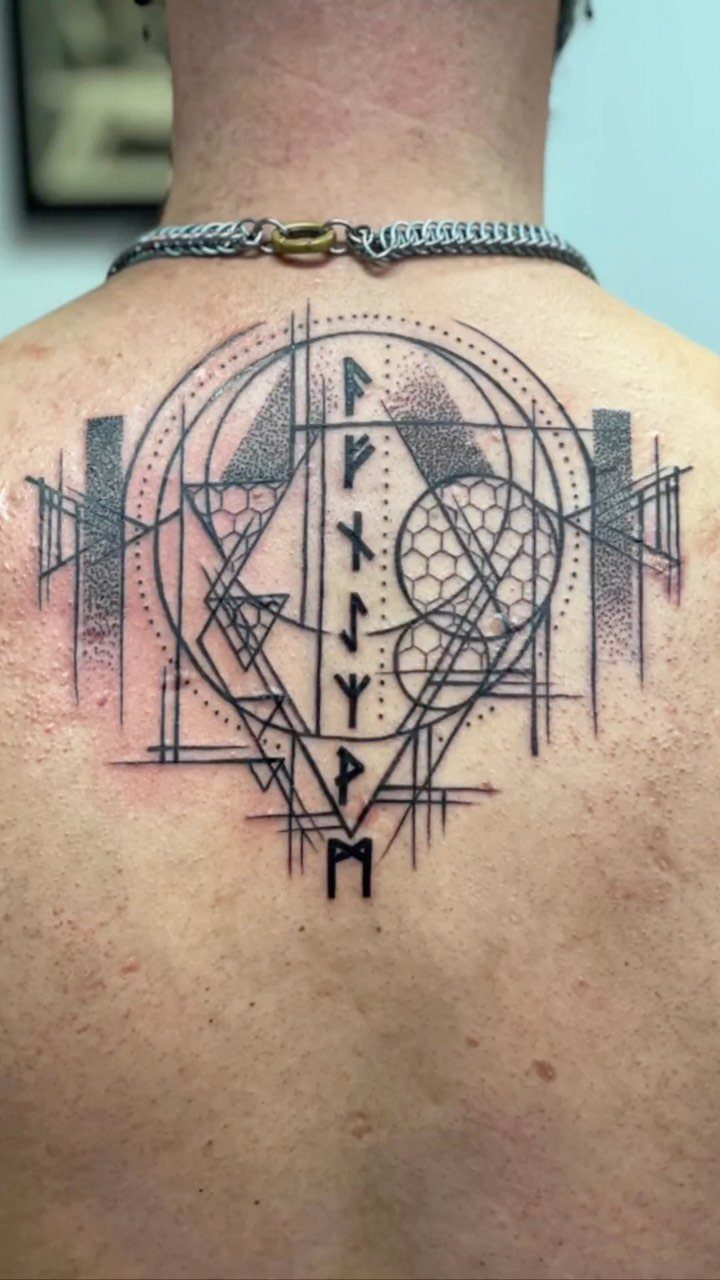
Sacred geometry gives runes a framework that feels modern without losing the old weight. Embedding vertical runes inside nested circles and triangles draws the eye to the center and then lets it travel outward.
This style lives or dies on how well the 2 sides mirror each other.
A geometric rune design that drifts even slightly off center looks like a mistake, not art. The stencil placement takes longer than the tattooing; do not rush it.
Upper back and neck placement stays visible with a tank top or open collar, hidden under a crew neck.
That range of show-or-hide suits someone whose workplace still cares about ink, though the neck edge will peek out of most collared shirts.

Viking bind runes symbols, elder futhark rune binding. Metal journal stencil, wicca stencil. Nordic runes script, Germanic futhark runes. Ogham runes. Bookmark mini rulers for planners

What you will get: Viking stencils for crafts has 6 pieces different pattern stencils, use airbrush stencils for walls furniture show your art easily.

COMPLETE KIT: Set includes 18 sheets of self-adhesive henna stencils featuring traditional Indian Mehndi designs for hands and body art
7. Back Rune Tattoo
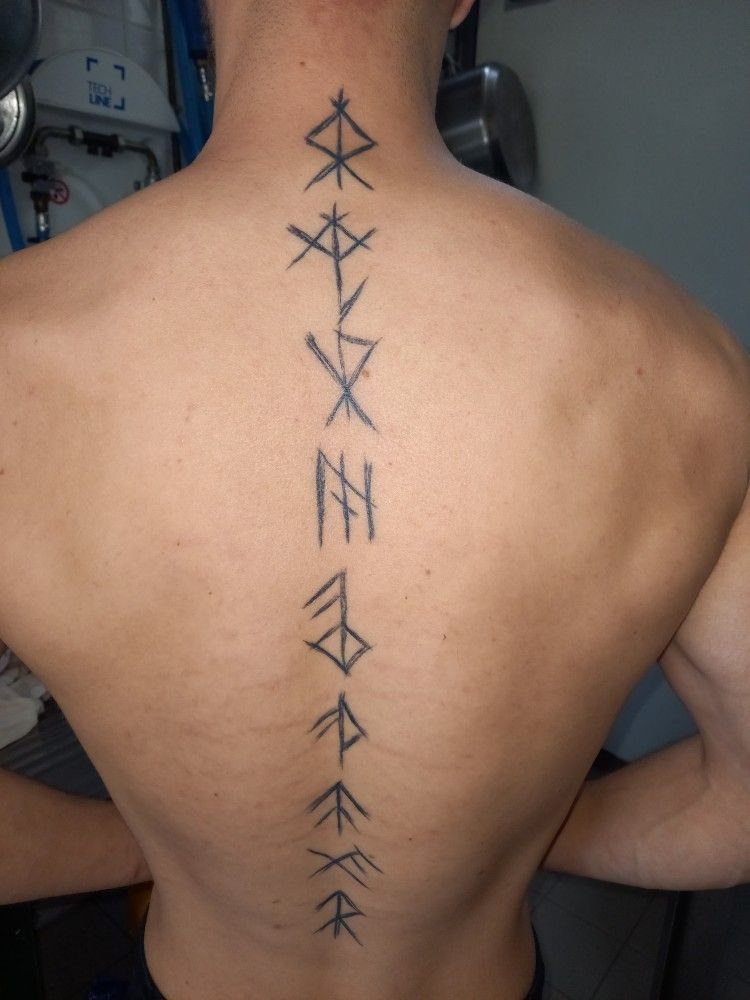
A vertical column of runes down the spine uses the back’s flat plane the way a page holds text: each symbol reads in order, top to bottom. The spine’s natural line keeps the column straight without fighting curves.
This placement suits larger compositions. The geometric radial pattern with dots and thin lines that some artists build around the upper back needs enough width to breathe; the spine column anchors it.
Pain runs higher here than on limbs.
The skin over bone vibrates more, and long sessions test most people’s stillness. Plan for two or three sittings if the design spreads wide.

MADE IN THE USA SINCE 1990: For over 30 years Dynamic Color has produced professional tattoo ink in the United States, an established American brand artists built their work on long before most imported labels existed.

MADE IN THE USA SINCE 1990: For over 30 years Dynamic Color has produced professional tattoo ink in the United States, an established American brand artists built their work on long before most imported labels existed.

100% brand new and high quality
8. Viking Rune Tattoos
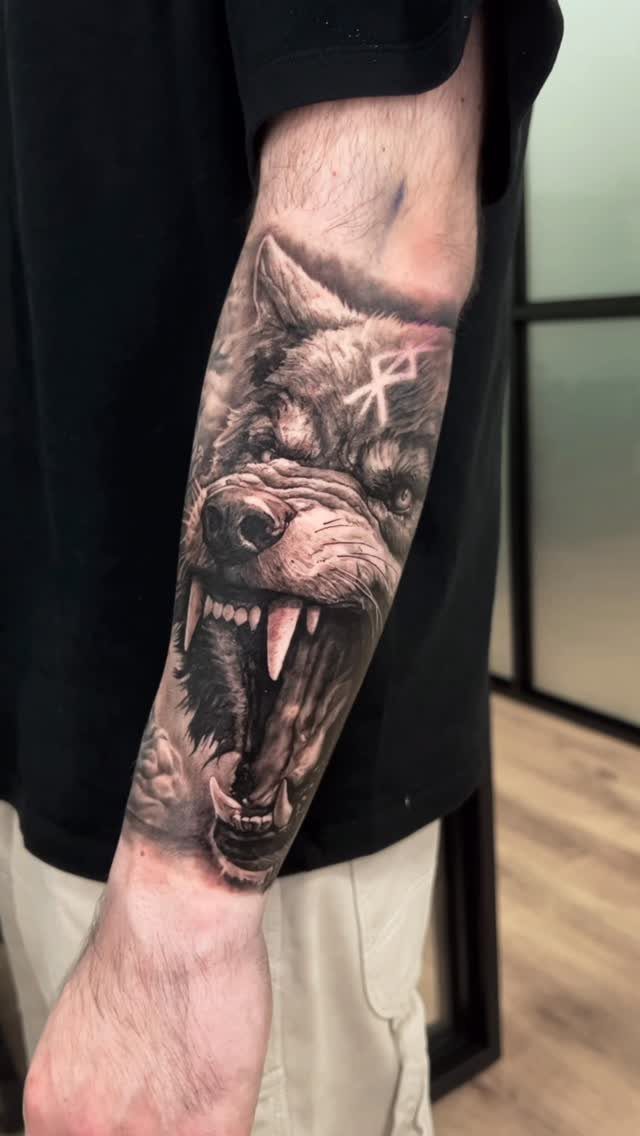
Viking rune tattoos usually mean one of two things: the Elder Futhark alphabet used by Germanic peoples before the Viking Age, or the broader visual language of symbols that tattoo culture calls Norse.
Black ink dominates this style. Color would read as comic book where the grey wash reads as saga.
If you want historically grounded runes, learn to recognize Elder Futhark shapes yourself.
Shops label flash sheets "Viking" that mix centuries and sources; the cross with three arms and two extra lines described in some bind rune sets has no basis in any attested runic system.

Celts, shield knot, protection symbol for all who love Nordic mythology, Celtic knots, germanic gods, Odin, Thor, Loki, Valhalla, Asgard, Scandinavian symbols, viking, warrior, Vegvisir, Valknut, Thors Hammer, runes, pagan art, Asatru, Paganism and Wicca.

SEAMLESS FACE MASK BANDANA SIZE :26 x 52 cm/10.2 x 20.4 inch (Wide x Long). Package Contents:4 X Face Mask Bandana.

Large Quantity Viking Tattoos : 77 sheets in total,17 sheets half arm sleeve viking tribal nordic fake tattoos in size 7.48"*3.74" and 60 sheets small viking tattoos in size 3.85"*2.28". Tribal Norse Viking temporary tattoos for adult men women kids
9. Raven Rune Tattoo
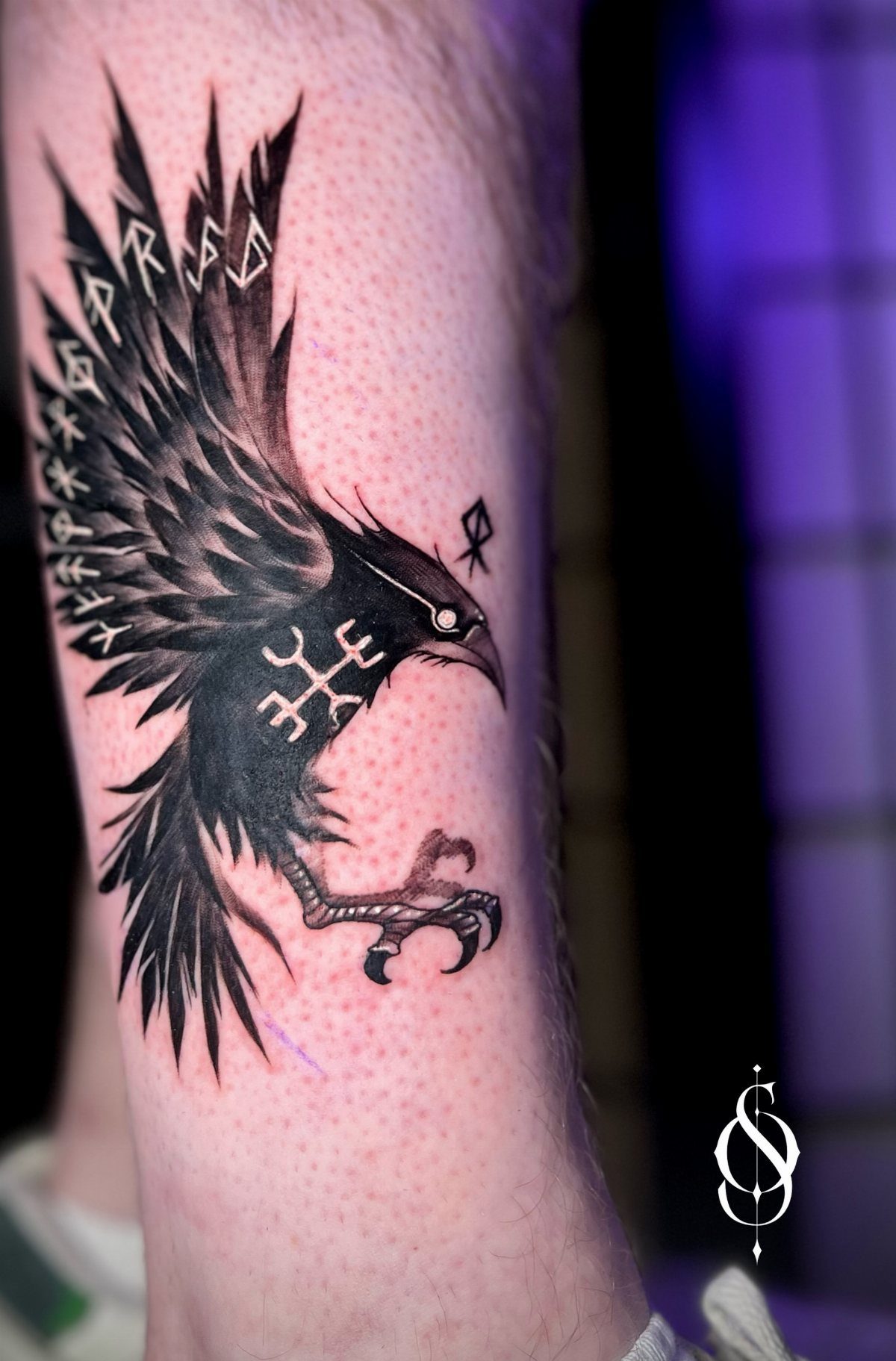
Odin’s ravens, Huginn and Muninn, pair naturally with runes because the birds themselves carried meaning in the old sources: thought and memory, the 2 things a tattoo might commemorate.
A single raven with runes worked into wing feathers lets the bird dominate while the symbols reward closer looking.
The half sleeve version with one raven and scattered runes needs planning for how the symbols read when the arm moves. A rune that sits right on a still stencil can twist to nonsense when the elbow bends.
Vertical spear or sigil designs suit the forearm’s length; raven compositions spread better across the shoulder or thigh where the bird’s wingspan opens.

Temporary Tattoos could be used for men women adults neck arm chest.

Realistic Finish: Different from you know ordinary temporary tattoo stickers or fake tattoos. It is so real and comparable to the real tattoo. It is a semi-permanent technology, Water-Resistant, friction-resistant, and can last for a long time, staying on your skin for 1-2 weeks.

Size Description: We have four sizes for you to choose from, suitable for most people
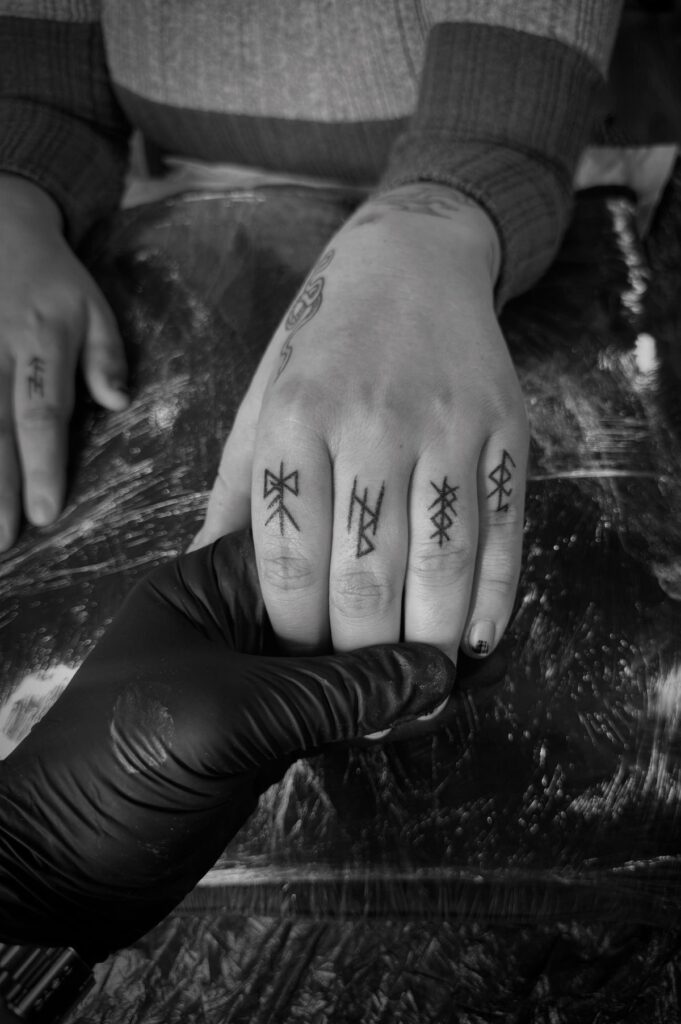
10. Finger Rune Tattoos
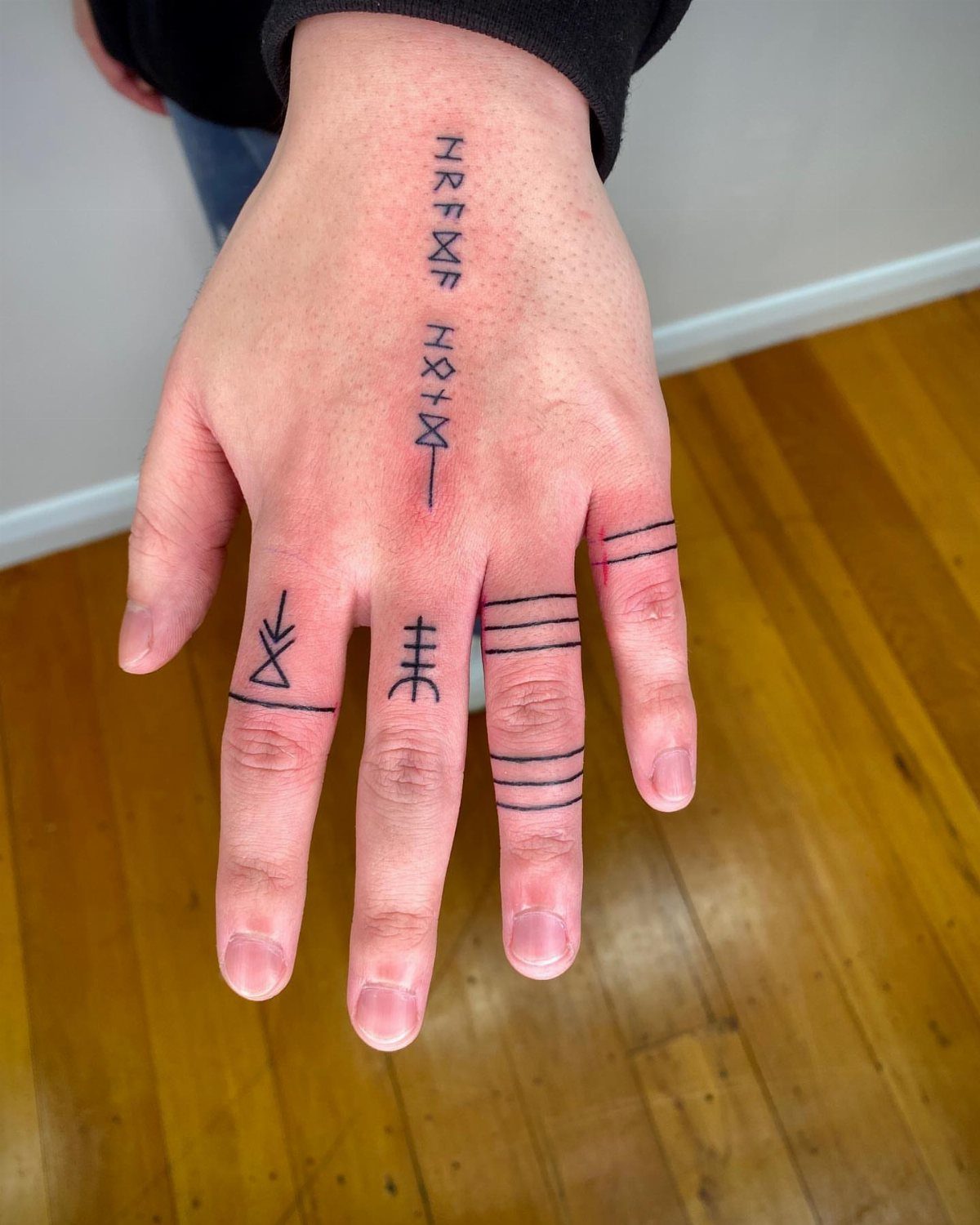
Finger runes face 2 hard limits: the skin regenerates fast, and the space is narrow. Fine lines and small dots blur on most people; bands across the finger joints fade fastest from flexing and washing.
Geometric shapes and crescents placed vertically on each finger, not across the joint, last longer because they sit on steadier skin.
The Y-shaped rune some sources show for fingers reads as a single symbol, not a word, which avoids the problem of misspelling.
Plan for touch-ups every few years. A finger tattoo that still looks crisp after the first round of healing is doing well.

Traveler, Backpacker. Perfect for Birthdays, Father's or Mother's Day, Anniversary, Christmas. Boxing, sports enthusiast, sporty, fighter, fighting, boxer, martial arts, ultimate artist, traditional, homeland, grappling, culture, mixed, tats. Sak Yant

Traveler, Backpacker. Perfect for Birthdays, Father's or Mother's Day, Anniversary, Christmas. Boxing, sports enthusiast, sporty, fighter, fighting, boxer, martial arts, ultimate artist, traditional, homeland, grappling, culture, mixed, tats. Sak Yant

Traveler, Backpacker. Perfect for Birthdays, Father's or Mother's Day, Anniversary, Christmas. Boxing, sports enthusiast, sporty, fighter, fighting, boxer, martial arts, ultimate artist, traditional, homeland, grappling, culture, mixed, tats. Sak Yant
11. Upper Arm Rune Tattoo
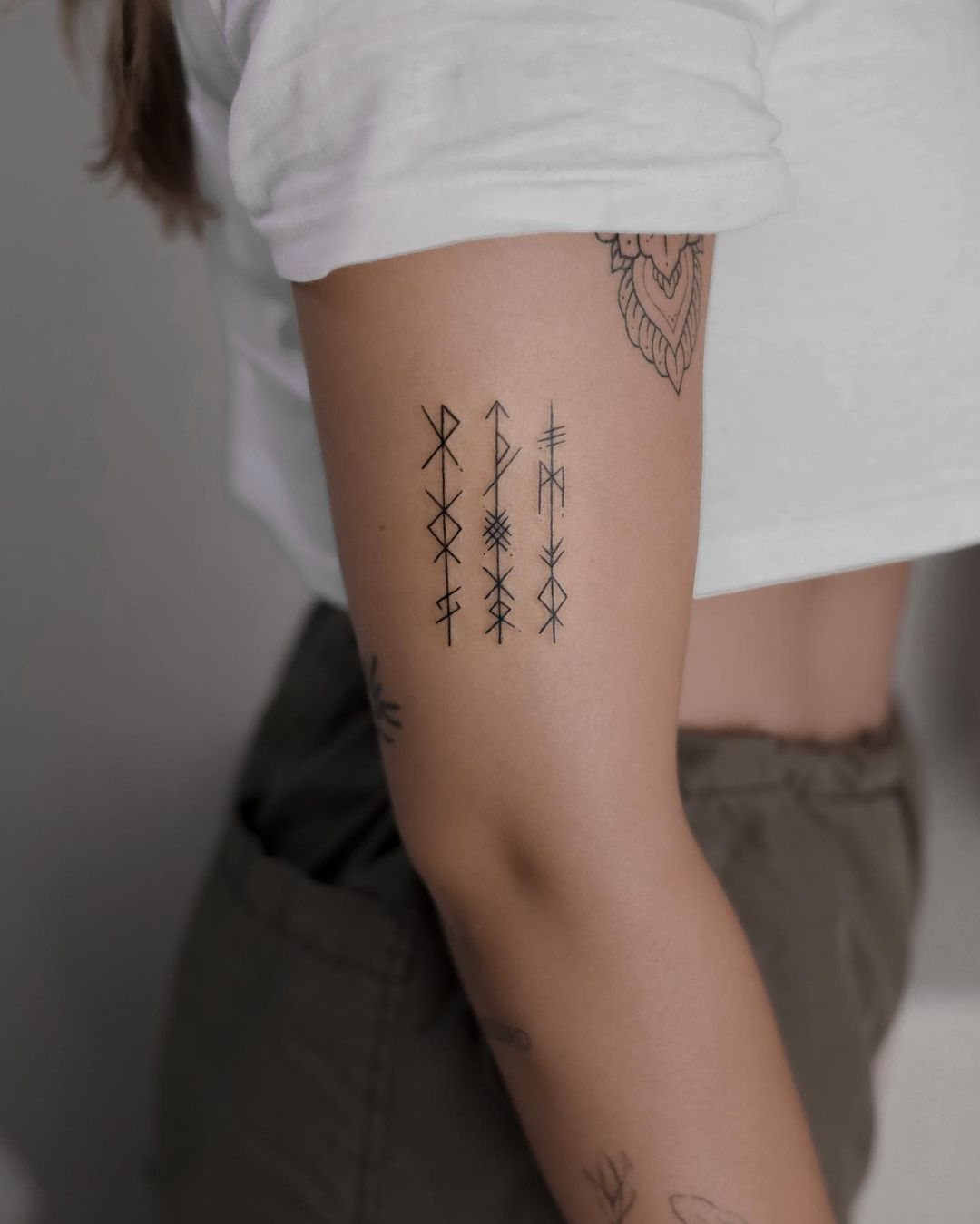
3 vertical columns of fine-line runes on the upper arm stack information the way a book page stacks lines: more density than a single column without crowding.
The upper arm’s cylinder shape suits this; the forearm’s twist would misalign the columns when the wrist turns.
Fine-line runes need a needle artist who works thin without going too shallow.
Lines that sit too high in the skin fall out; lines too deep spread and blur the geometric precision. The diamond shapes and symmetrical patterns that accompany good rune work depend on that precision.
Sleeveless shirts show this placement; a fitted tee hides it. That range works for most workplaces now.
12. Face Rune Tattoo
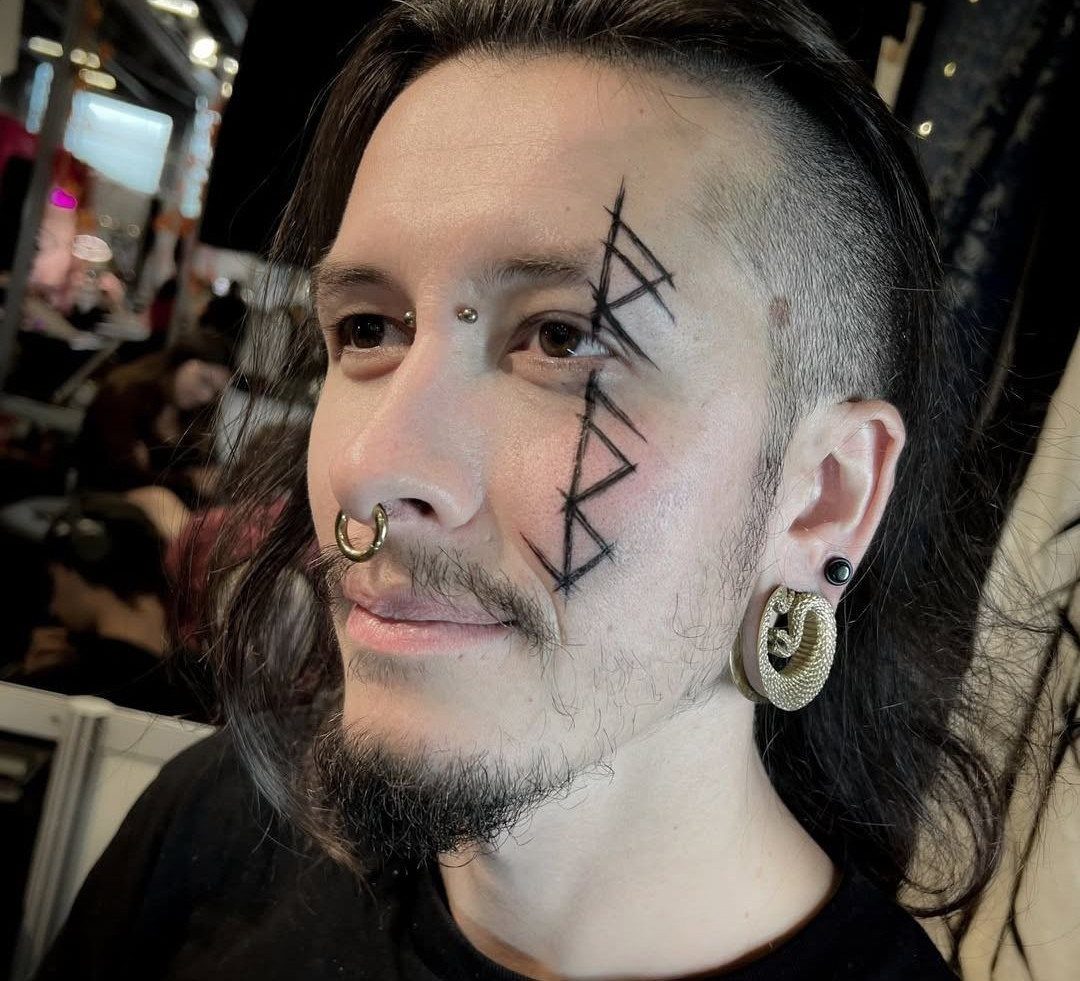
A rune on the face is the most visible tattoo choice possible: no shirt covers it, no angle hides it, and most societies still read facial ink as threat or breakdown before they read it as art.
The geometric pattern across temple, cheekbone and eye socket follows bone structure the way a mask follows a face.
This placement limits employment in ways other ink does not. The piercing and shaved head in the visible version signal a subculture commitment that employers in service industries, finance, law and medicine routinely screen out.
The line work must be precise.
Facial skin moves constantly with expression; a stencil placed on relaxed skin shifts when the muscle fires. Ask specifically about experience with facial placement, not just with runes.
13. Side Torso Rune Tattoo
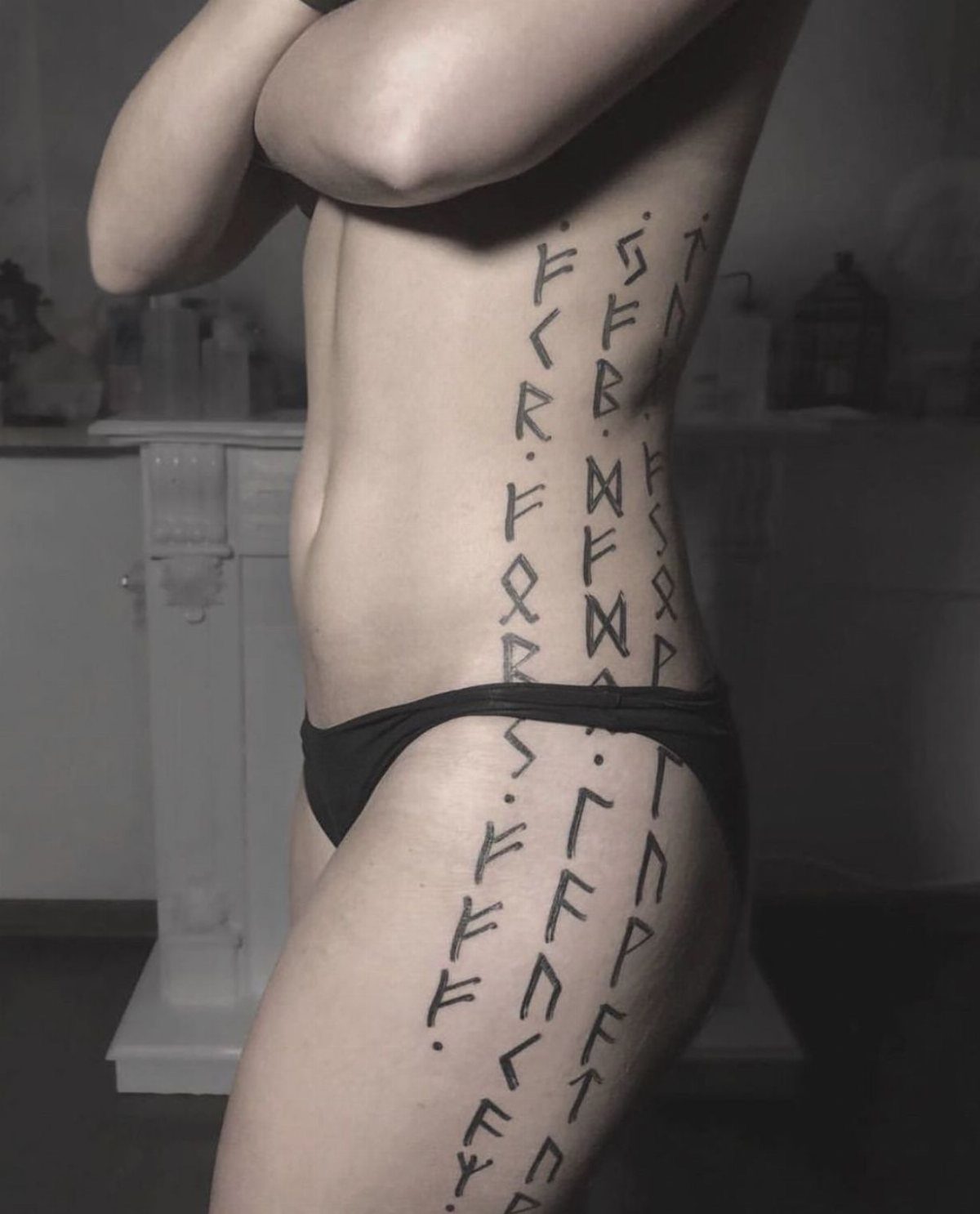
Vertical runes down the ribs and hip follow the body’s natural grain the way text follows a page, but the canvas moves with every breath.
The skin here stretches and compresses constantly; a column that reads straight at rest can skew when you raise your arm or twist.
Multiple columns need spacing planned while standing, not lying on a shop table.
Gravity shifts everything. The hip bone and lower ribs create hard edges that interrupt flow; an artist experienced with side placement knows to adjust column width to avoid symbols riding the bone ridge.
This placement hurts more than limbs.
The thin skin over ribs vibrates against bone, and sessions run long if the design reaches from armpit to thigh. Plan for breaks.
14. Yggdrasil Tree Rune Tattoo
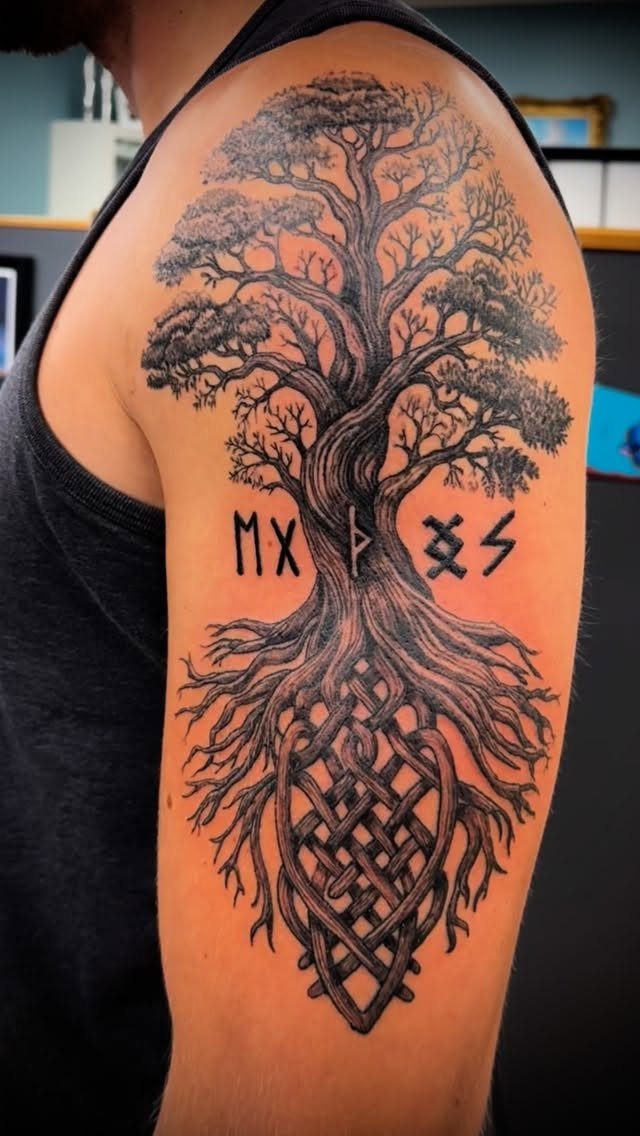
Yggdrasil with runes woven through its trunk layers 2 symbol systems: the tree as cosmic structure, the runes as specific meaning you choose.
The trunk’s vertical line suits the upper arm’s cylinder; roots can wrap toward the elbow or shoulder depending on where you want the eye to travel.
Black and grey shading gives the bark texture without color that would compete with the runes for attention. Decide whether the runes spell something legible or serve as texture; half-legible runes frustrate readers and look accidental.
The circular Vegvisir-and-runes variation some artists build around the tree needs more flat space than the upper arm alone. Chest or back placement holds that composition better.
15. Hand Rune Tattoo
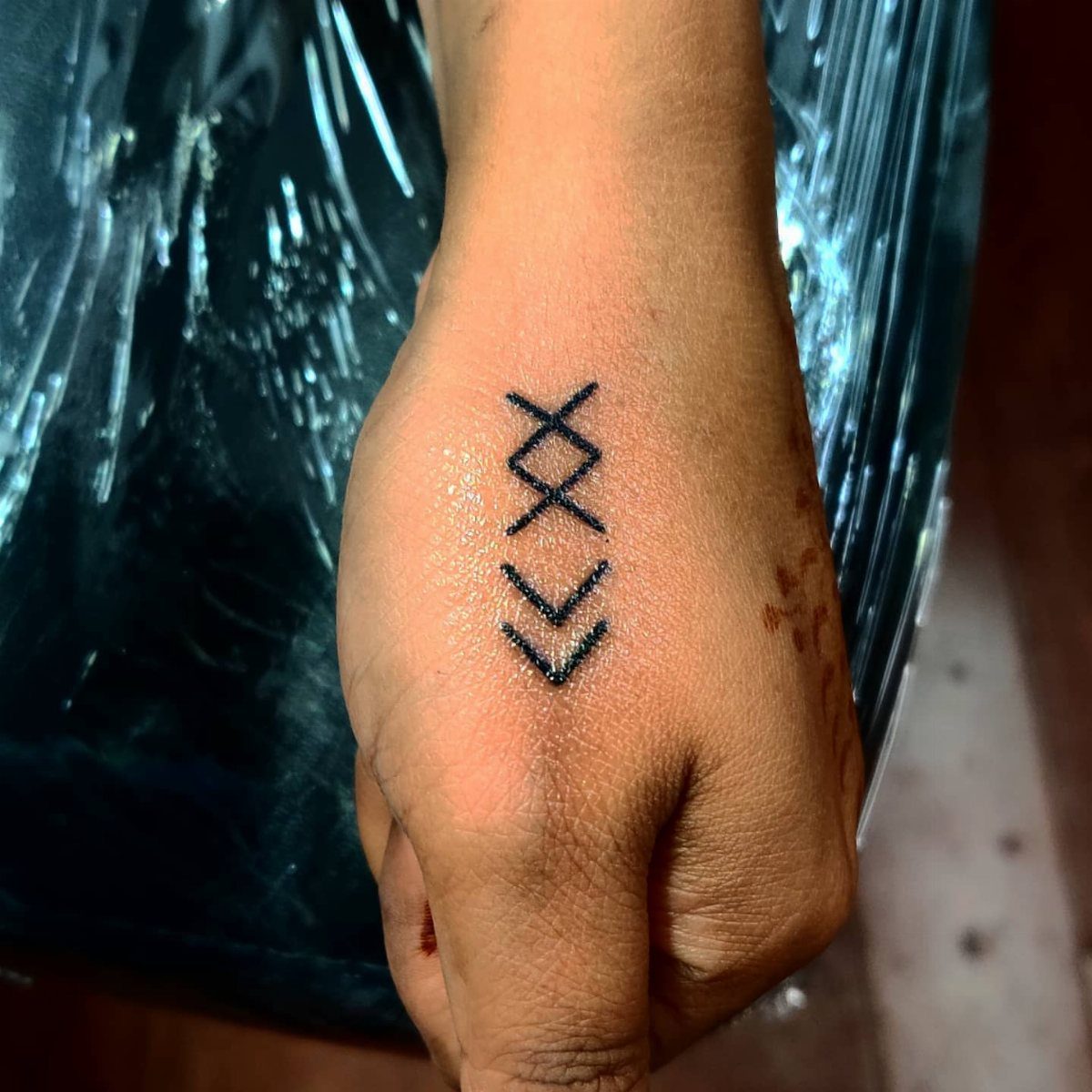
A single rune on the back of the hand reads clean from across a room, which is exactly the problem: no handshake, job interview, or family dinner lets you hide it.
The geometric precision visible here depends on the artist’s steady hand against thin, mobile skin that shifts with every finger movement.
Hand tattoos age fast.
The back of the hand sees sun, friction, and washing that fades ink faster than almost anywhere else. A minimalist design with solid black lines, not fine detail, holds up longest on the hand where skin takes a beating.
Touch-ups within 2 years are standard, not a sign of poor work. Budget for them.
16. Rune Sleeve Tattoo
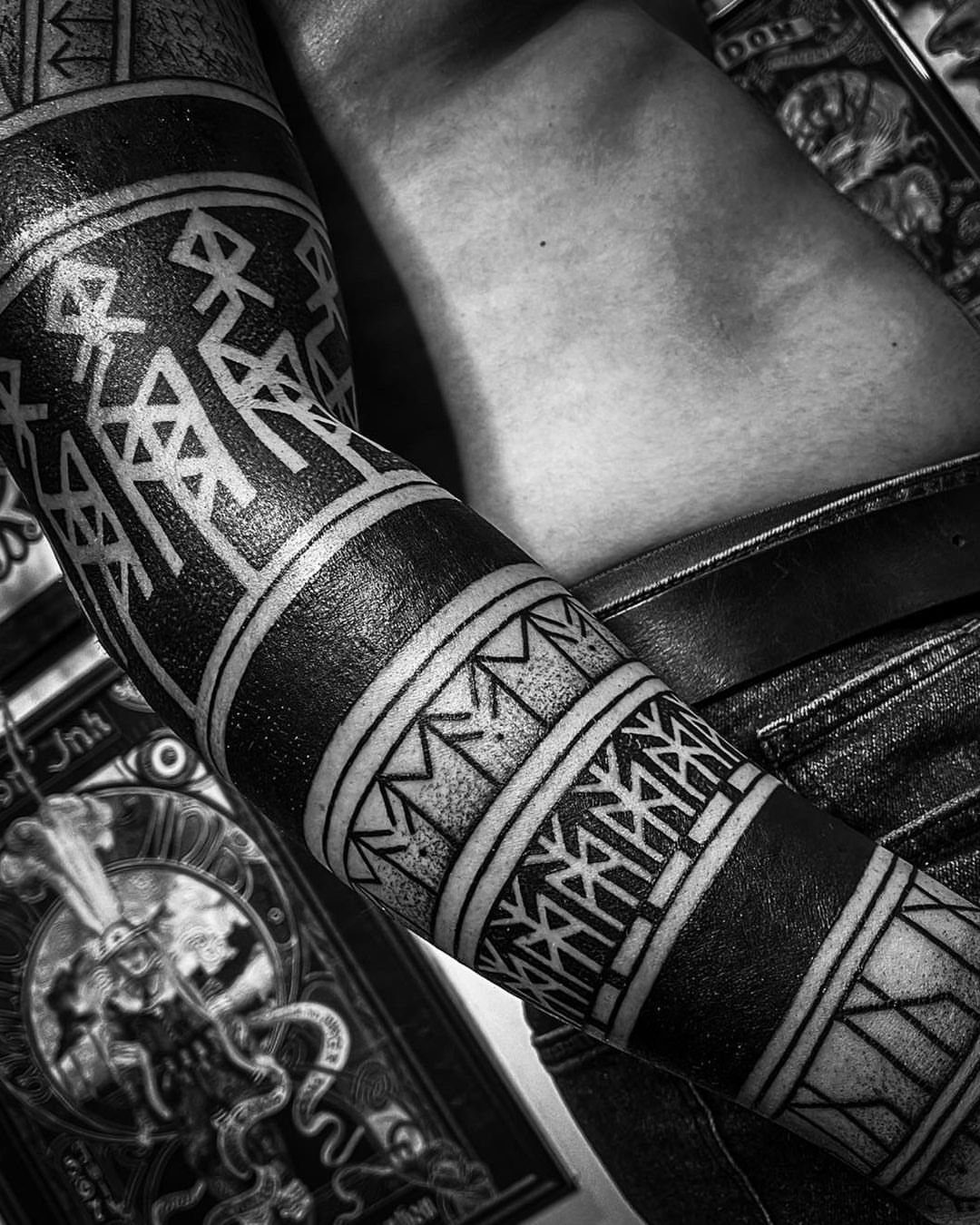
A full sleeve of runic bands and geometric blackout asks for commitment in time and skin: this is not a first tattoo choice for most people.
The dense black bands in the visible version create negative space where runes float, a reversal of the usual light-background approach.
Blackout work takes multiple sessions; the skin can only absorb so much ink before it needs healing time.
A rune sleeve comes together in sessions spread across months, not days, since healing has to happen between rounds. The geometric patterns require an artist comfortable with large-scale symmetry; a band that drifts off true reads as sloppy, not stylized.
The half-sleeve option with raven integration, from the same artist family as this full sleeve, offers a smaller entry point to the same visual language.
17. Antlered Skull Rune Tattoo
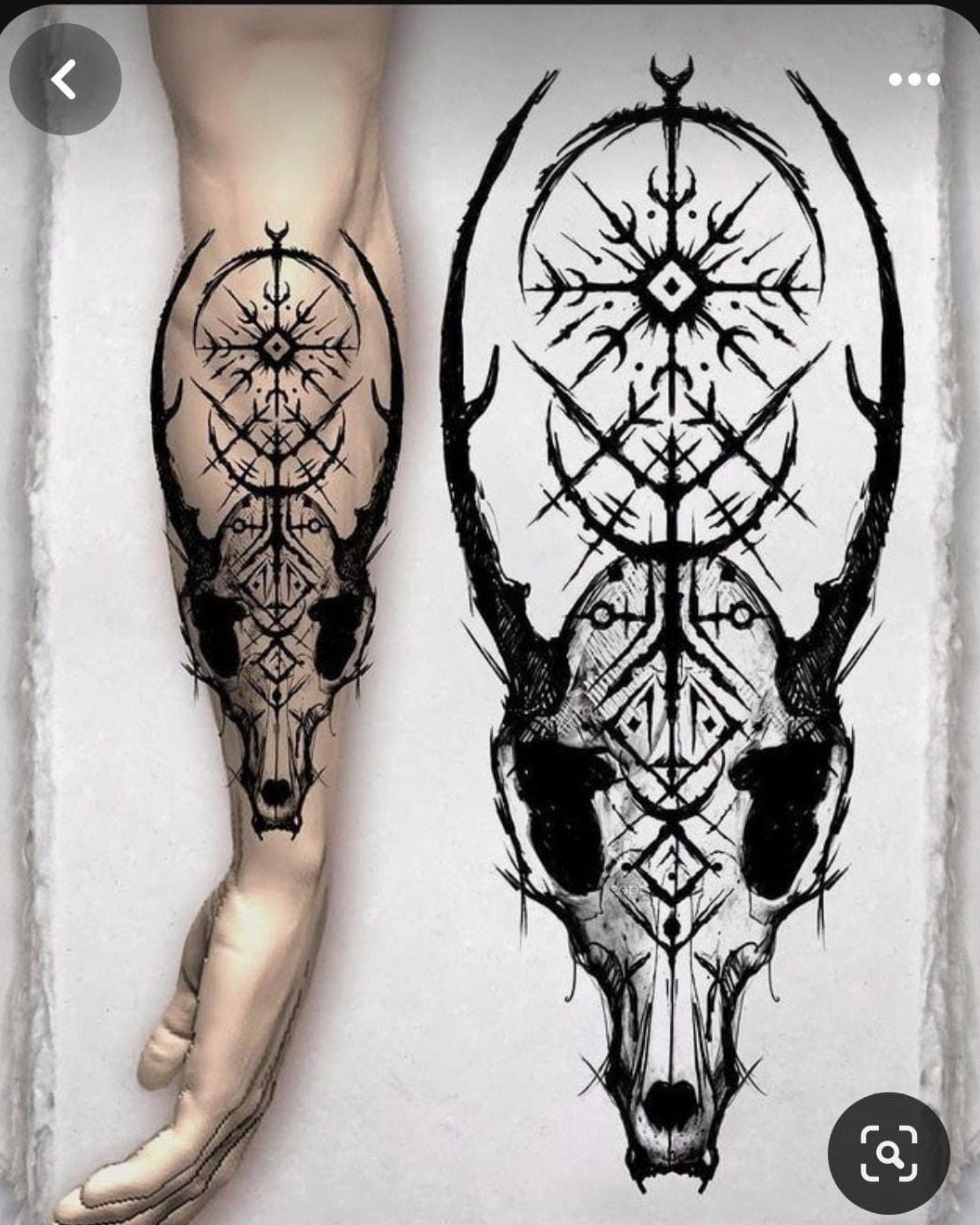
An antlered skull merged with runic geometry on the forearm combines animal presence with symbol density. The skull’s eye sockets and nasal cavity create natural negative space where runes can sit without crowding; the antlers frame the composition upward.
Forearm placement means constant visibility and constant sun exposure.
The black ink in the visible version will grey over time; a design this detailed needs that contrast to hold its readable layers. Sunscreen becomes maintenance, not option.
The flash illustration beside the mockup shows the design’s intended line weight; compare your artist’s stencil to it before starting. Geometric elements that look correct at illustration scale can blur together when skin-aged.
18. Valkyrie and Wolf Rune Tattoo
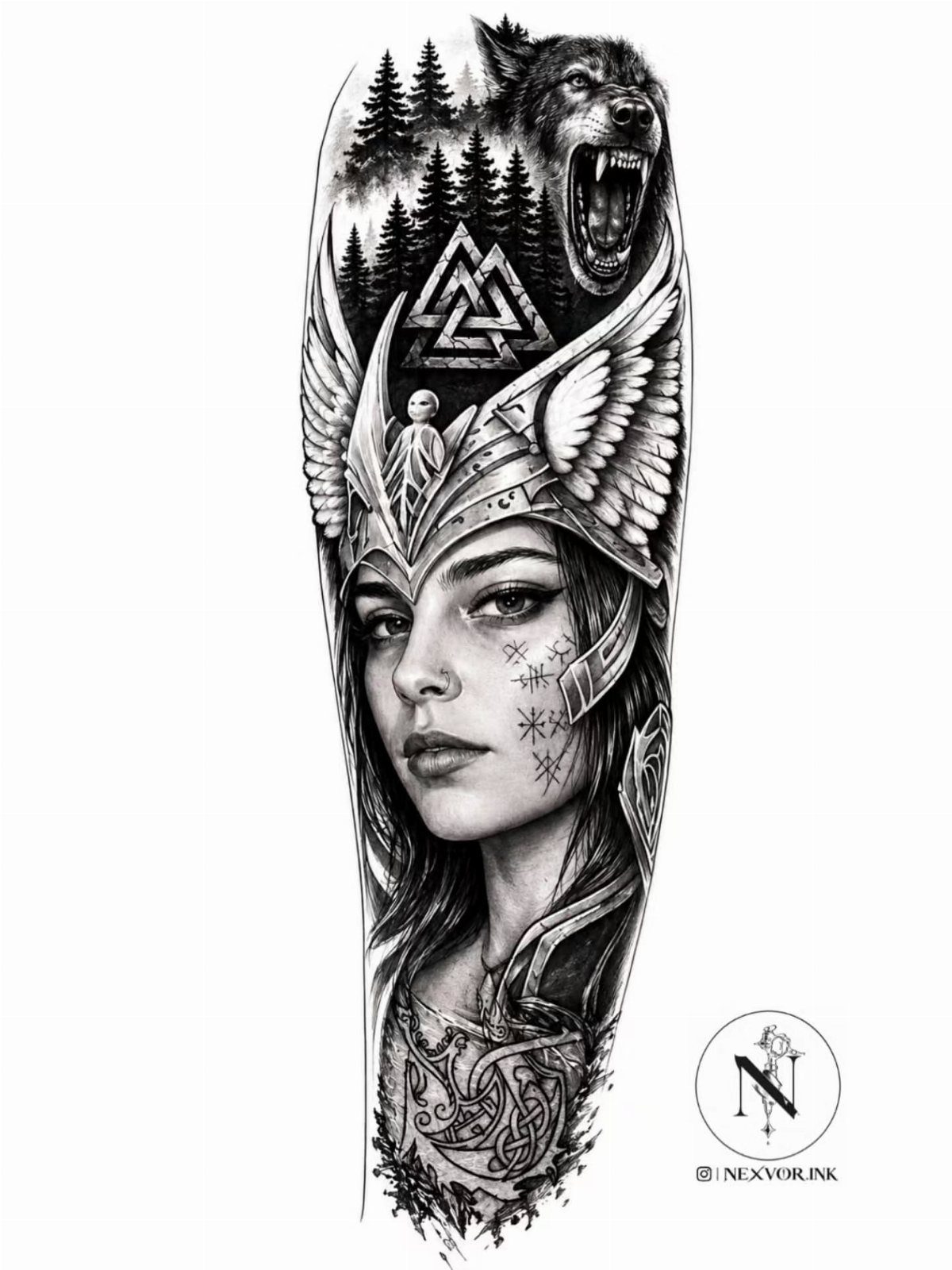
A Valkyrie with facial runes, wolf, and forest builds a narrative scene rather than a single symbol, which changes how the runes function: they become part of her character, not a message you wear.
The vertical format suits the outer arm or calf, where height matters more than width.
The wolf’s placement relative to the figure creates movement; too close and the composition clutters, too far and the elements read as separate tattoos. The pine trees in the background add depth that separates foreground from background without color.
Face runes on the Valkyrie herself raise the same question face runes on you would: do they spell something, or decorate? The design works either way, but the artist needs to know which before inking.
Symbolism of Rune Tattoos
Rune tattoos carry meaning through a system that was never only decorative. A rune chosen for protection, like Algiz, draws on that history whether the wearer studies it or not.
A rune that looks like strength to you because of its angular shape might mean inheritance or inheritance-law in the historical record. Shops rarely catch this; the burden is on you to match the symbol to the intention.
Personal strength in this context is not generic empowerment. Uruz, the wild-ox rune, carries connotations of untamed force and endurance that fit a specific temperament better than a calm, steady resolve.
Fehu, cattle and wealth, suits someone marking a material goal. The rune does the narrowing for you if you let it.
What Runes to Avoid Tattooing?
Some runes carry weight you might not want on your skin permanently.
Sowilo, the sun rune, was adopted by Nazi Germany and appears in neo-Nazi iconography; the rune itself is ancient and positive, but the association has poisoned it for public reading. Othala, inheritance and homeland, faces the same contamination.
Other runes are simply easy to confuse.
Eihwaz and Algiz look similar to an untrained eye; one means yew tree and endurance, the other protection. A tattooist working from a flash sheet might not know which you requested.
The bind rune problem compounds this. I have seen portfolios where the artist proudly displayed a bind rune that spelled nothing, or that combined contradictory concepts the wearer clearly did not intend.
Research means checking multiple sources, not one Pinterest pin. The notes you find there are often copied from copies, each generation adding error.
Tattoo Placement Advice
Visibility and significance pull in opposite directions.
The forearm works well because you can see it yourself and others can too, not because any body part carries special rune meaning.
The flat plane lets a column of runes read straight, and the bone underneath gives the artist steady resistance.
Back placement suits vertical composition because the spine provides a center line, but the wearer never sees it without mirrors. A rune meant as self-reminder loses function where you cannot check it.
Pain varies by location in ways that matter for session length.
Ribs and spine, noted above, test stillness; a long column of runes there may need splitting across appointments. Limbs allow longer sits, which matters if the design is dense.
Frequently Asked Questions
What runes should I avoid tattooing?
Sowilo and Othala carry Nazi-era contamination that makes them read as hate symbols in public, even though both are ancient and positive in origin. The burden of matching symbol to intention falls on you, not the shop.
What does a rune tattoo symbolize?
Rune tattoos carry meaning through a system that was never only decorative: Algiz for protection, Uruz for untamed force and endurance, Fehu for cattle and wealth.
A rune chosen for its angular shape might mean something else in the historical record, so matching the symbol to your specific intention matters. Personal strength is not generic; the rune does the narrowing for you if you let it.