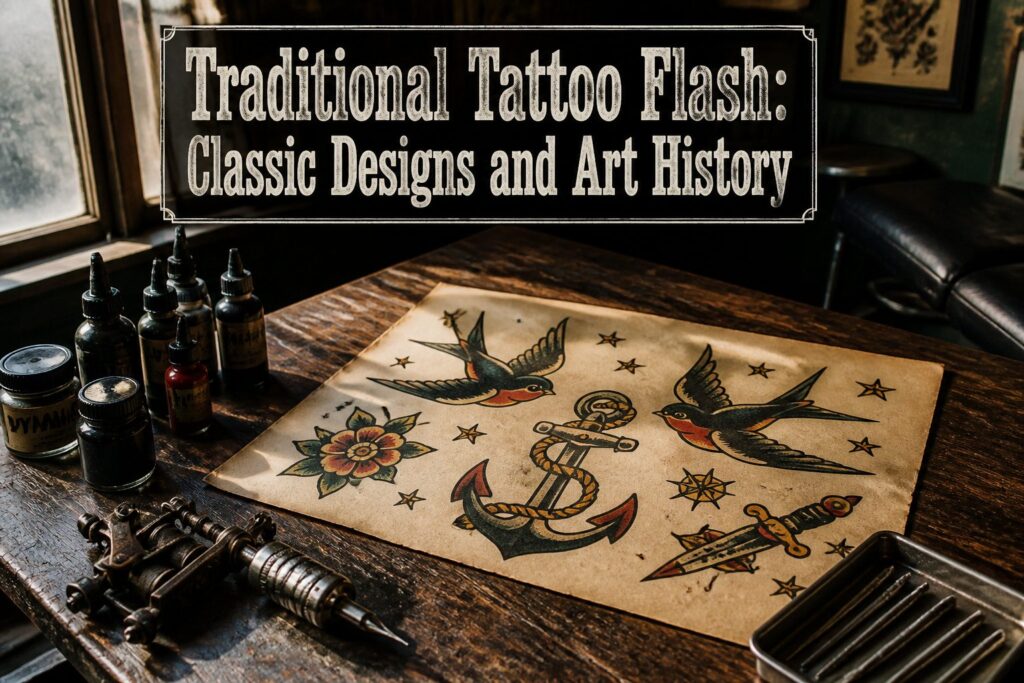
Traditional tattoo flash is the pre-drawn art that once covered the walls of American shops, standardized by speed rather than theory.
What actually survived was not the prettiest work but the boldest: thick black outlines and flat color that could be copied fast, heal hard, and still read across a smoky bar.
Norman "Sailor Jerry" Collins built the visual grammar we still recognize, codifying anchors, swallows, and pin-ups into a shared language born on waterfront flash sheets.
Anchors
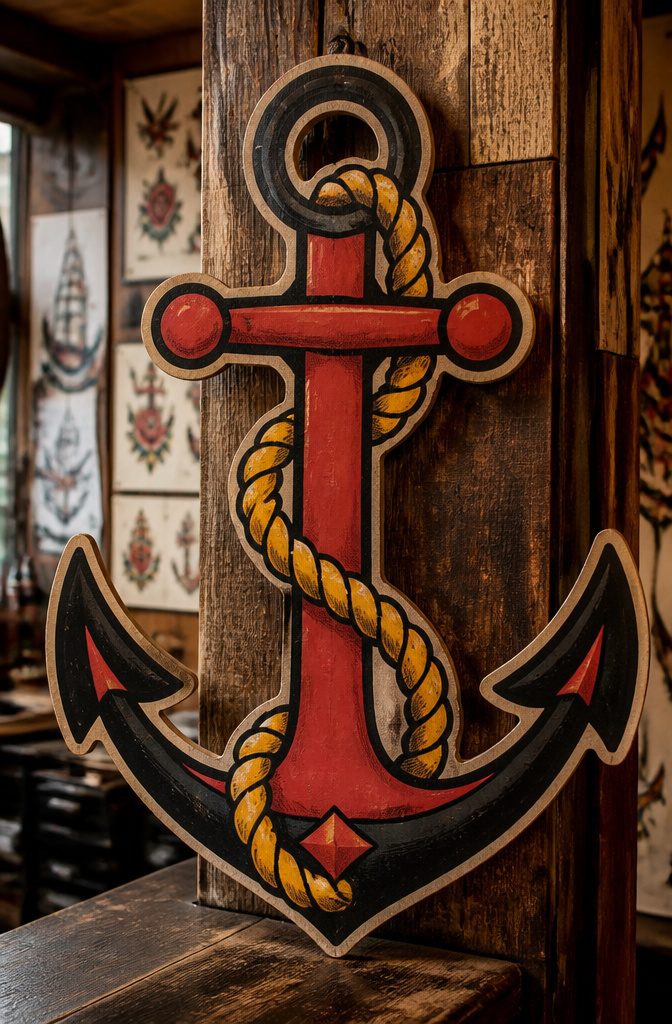
The anchor sits at the heart of traditional tattoo flash for a reason that has nothing to do with naval mechanics.
It means you stay — stability, faithfulness, the person who does not drift. That symbolism grew out of a practical fact: sailors of the early 1900s wore them first, often after crossing the Atlantic or reaching some milestone at sea.
The design was already on the flash sheets hanging in waterfront shops, ready to ink fast before the ship left port.
Norman "Sailor Jerry" Collins turned this workaday mark into something you still see on walls today. His anchors carried weight — thick black outlines, a shaft of solid red, maybe a rope in yellow or green that popped against skin.
The colors were limited and loud, the linework bold enough to hold after decades of sun and age.
Collins built the visual language that makes an anchor read as "traditional" the moment you spot it, not because he invented the image but because he codified it: simple geometry, no shading tricks, the faith that a clean shape does more than a busy one.
What draws me to these pieces now is how little they need.
An anchor flash from the 1920s and one from last week share the same bones. The loyalty it promises does not date.


Swallows
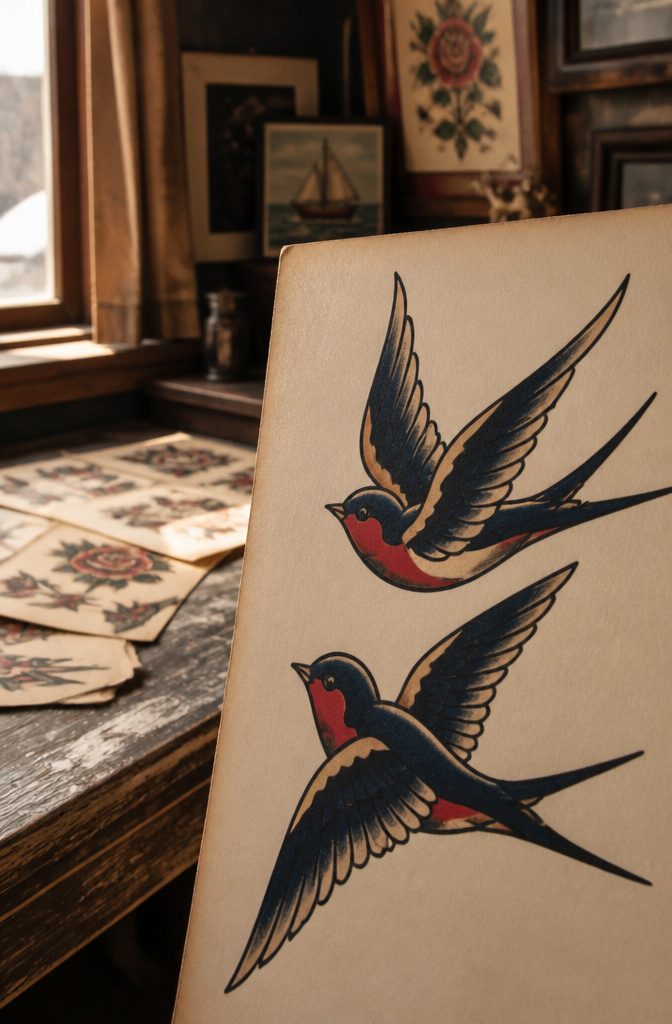
Swallows carry one of the oldest readings in traditional tattoo flash: safe travel and return home.
Sailers inked them after sailing a set number of miles, turning the bird into a logbook etched in skin. Two swallows meant the voyage was done, the bearer back on solid ground.
The design strips everything to essentials. A pointed tail, forked wings spread flat, maybe a small banner or a rose in the beak if the artist wanted to fill space.
Colors stay tight: navy, red, black, with green used sparingly for leaves. Thick black outlines do the heavy lifting so the image still scans from across a room or through twenty years of sun and skin change.
That restraint is why swallows survived when flash sheets yellowed and shops changed hands. A sailor in 1940 and a rider today could wear the same stencil and mean roughly the same thing.
The limited palette helps here: fewer colors means fewer decisions where age will blur the edges. For placement, the chest and hands stayed popular because the bird’s spread wings match the body’s geometry without twisting the form.

THE QUALITY OF STENCIL1: Stencil1 was born from a tradition of handmade customized crafting, painting, and creating. With a lifetime of DIY experience creating stencils and art, Ed Roth started a business bringing the highest quality stencils to homes across the USA. 🇺🇸MADE IN USA

Durable & reusable airbrush stencil for creating realistic tattoos

High quality fashionable temporary tattoo, which looks like real
Roses
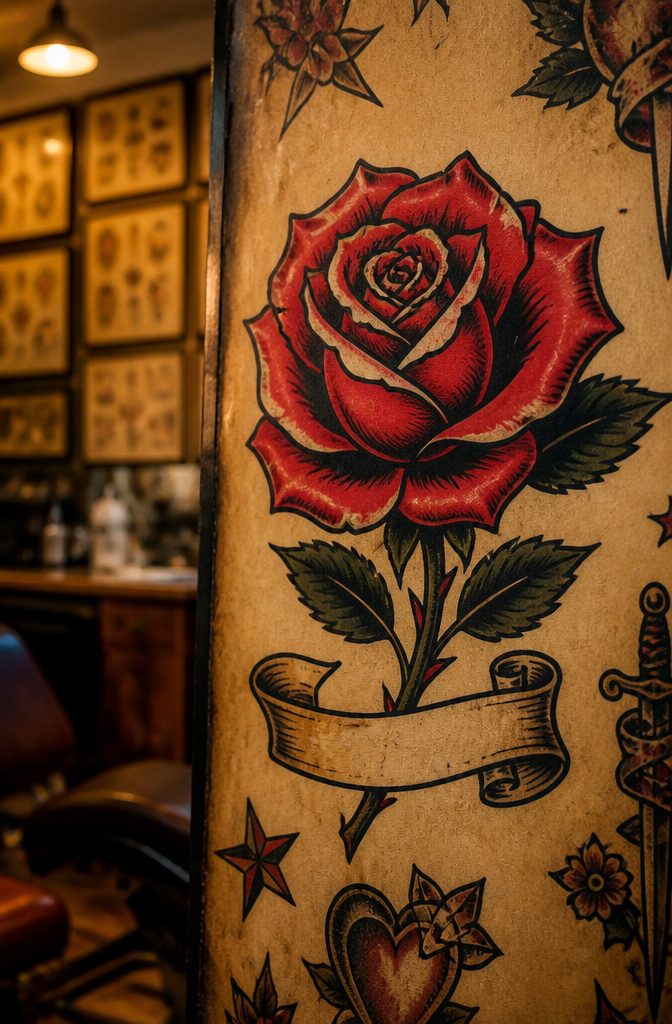
A rose in traditional flash carries its weight almost instantly.
Bold black outline, flat reds and greens, maybe a banner curling underneath with a name or a date. Sailors got them for girls back home, and the meaning stuck: love, beauty, the soft thing worth protecting.
What keeps the rose from turning sentimental is the company it keeps in classic sheets. A dagger through the bloom or a skull nestling in the petals keeps the design honest, the sweetness cut with something harder.
The style itself enforces restraint. Limited palettes mean the red hits once, without shading into pink softness.
The green leaves read as blocks of color, not botanical accuracy. That discipline keeps a traditional rose readable from across a room and at twenty years’ distance.
When I flip through old flash, the pieces that aged badly usually tried to add too much: extra petals, softer lines, colors bleeding outside the armor of the black.
The classic formula survives because it trusts the symbol to do the work.

Traditional Tattoo Flash Design: Features a bald eagle, coiled snake, dagger and rose, sacred heart, red roses, swallow, horseshoe, stars, and classic bold outlines for a bold vintage tattoo focal point in your room.

TRADITIONAL BIRD ART: Features a classic set of traditional flying birds, dynamically designed to soar in pairs. This iconic artwork perfectly showcases classic American Traditional and old school tattoo aesthetics, featuring bold black outlines, solid color fills, and heritage dotwork shading on the wings.

𝗜𝗡𝗖𝗟𝗨𝗗𝗘𝗗: You will get 48 little custom tattoo sheets filled with american traditional style tats. This hand tattoo set is perfect for any old school traditional tattoo and blackwork lovers. Our high quality semi permanent tattoo ink is long lasting, providing you the real looking tattoos that you can reply on for several days. Beautiful designed faux tats come in a variety of sizes and designs.
Pin-Up Girls
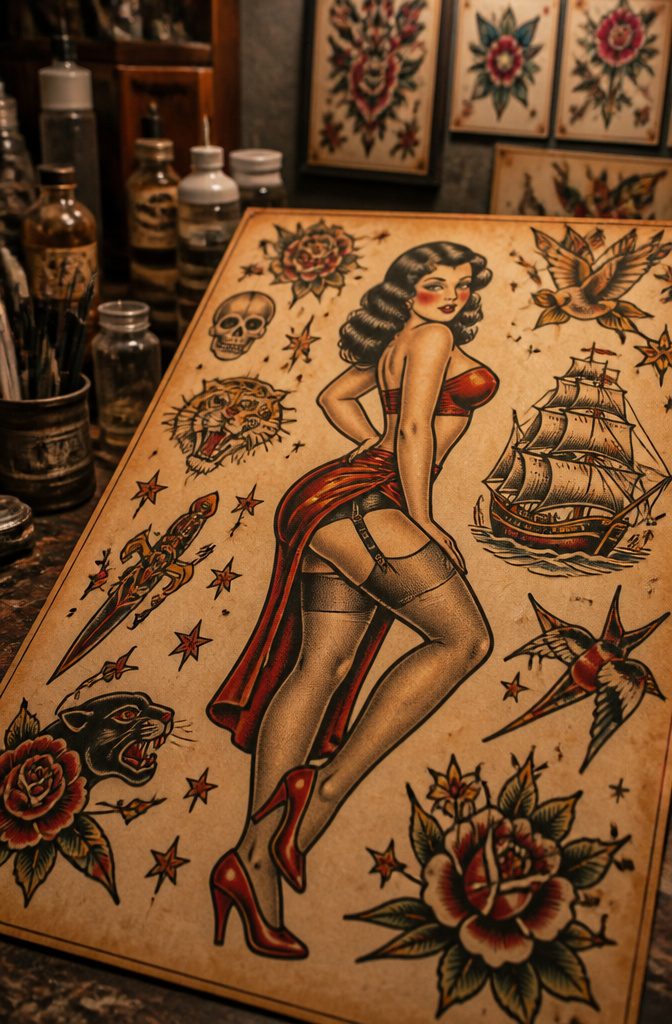
Few flash subjects carry the cultural weight of the pin-up girl, a staple that emerged from early 1900s sailor culture and mid-century illustration.
Sailors at sea sought these pre-drawn designs as tokens of nostalgia and fantasy, reminders of the women waiting back home or imagined encounters in ports they’d yet to reach.
The imagery leaned heavily on pulp magazine and calendar art of the era, with artists like Norman "Sailor Jerry" Collins refining the bold lines and bright colors that made these figures readable even decades later.
What strikes me is how this particular flash motif outlived its original context. The pin-up persisted not because sailors still dominate tattoo shops, but because the visual language became synonymous with traditional tattooing itself.
A well-executed pin-up in classic flash still relies on the same limited color palette and strong outlines that defined the 1920s sheets. The fantasy element remains intact too, though the audience has broadened far beyond its original military clientele.
For someone choosing traditional tattoo flash today, the pin-up offers something many modern designs sacrifice: an immediate, legible story rooted in actual history. It reads as vintage without requiring explanation.

77 sheets american traditional temporary tattoos,17pieces 7.48*3.74 and 60pieces 3.85*2.28,including sailor,anchor,snake,eagle,sailboat,sailor, pentagram,lighthouse,heart,swallow,flower,vintage roses,swallows,demon,butterflies,sword,skull,eagle,scorpion

[LARGE QUANTITY] There are 2 different size temporary tattoos with a large amount. Large size flower tattoo stickers size is 7.48 * 3.74 inch (19 * 9 .5cm) 17 sheets, small lovely tattoos‘ size is 3.9 * 2.3 inch (9.8 * 5.8cm) 60 sheets. Share and enjoy it with your family and friends
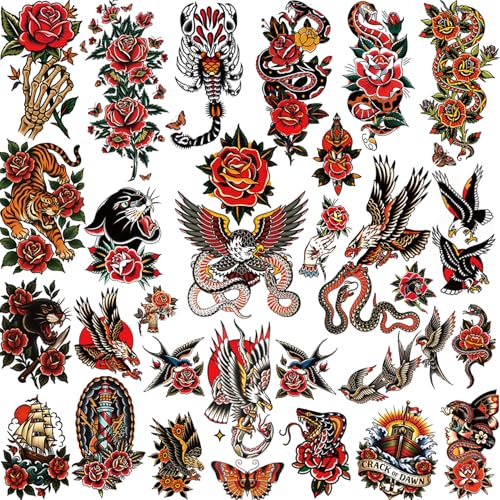
Large American Traditional Colorful Tattoo Stickers: 12 sheets of super large classic adult temporary tattoo stickers, old-fashioned traditional tattoo stickers are designed for adults. These retro traditional American elemental tattoos are creatively designed by our artists and are 4.72*9.06 inches in size. These waterproof fake tattoos look very realistic, artistic, eye-catching, and make you shine like a star. Enjoy expressing yourself with these American old tattoos
Hearts
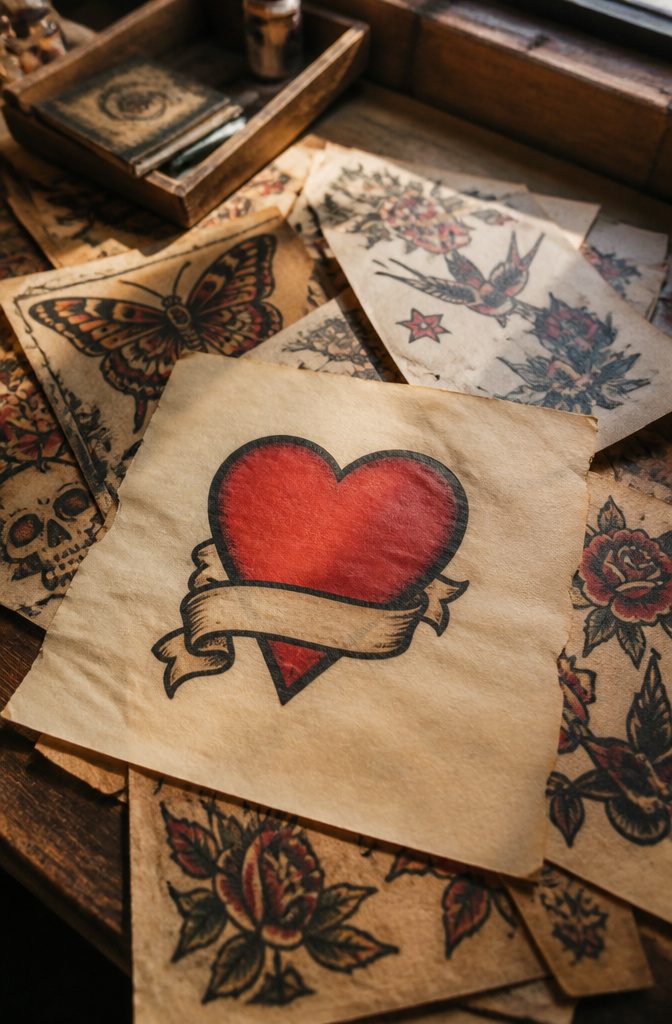
A simple heart with a scroll and someone’s name is probably the first design most people picture when they think of traditional flash.
The style dates back to the days when walk-in customers picked straight off the wall, and the formula barely changed: bold black outline, limited red palette, a banner ready to be lettered with whatever name the customer brought in.
It was romantic in a practical, almost matter-of-fact way, like getting a haircut.
The sacred heart pushed that same imagery toward devotion with more layers than a standard namesake piece.
Thorns wrap the muscle, flames rise from the top, sometimes a cross sits in the center, sometimes drops of blood. Catholic iconography gave traditional artists ready-made drama, and the style handled it well at small sizes.
A sacred heart on a forearm reads instantly from across a room; the same design on a chest panel holds up for decades because the heavy black lines and saturated color do not depend on fine detail that falls out.
Loss and remembrance show up in the flash too, though less explicitly. A heart broken by a dagger, a heart with wings ascending, a heart paired with the word "Mother" in a memorial piece.
The symbolism stays direct because the format demands it. Traditional flash was sized to be finished in a single sitting, priced for working people, and designed to heal fast and read forever.
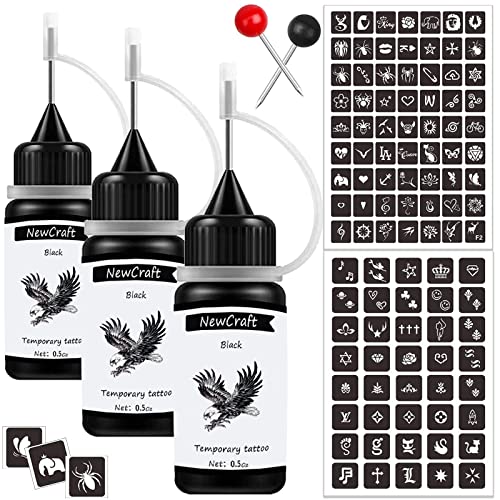
PACKAGE CONTENTS: There are 3 packs black temporary tattoo ink, 103 patterns tattoo stencils and one pin included in this comprehensive kit


Striking vintage tattoo flash artwork featuring an angry black cat with arched back, bristling fur, and fierce expression. Ideal for fans of old-school tattoo art, classic feline symbolism, retro flash imagery, and bold traditional designs with attitude.
Nautical Stars
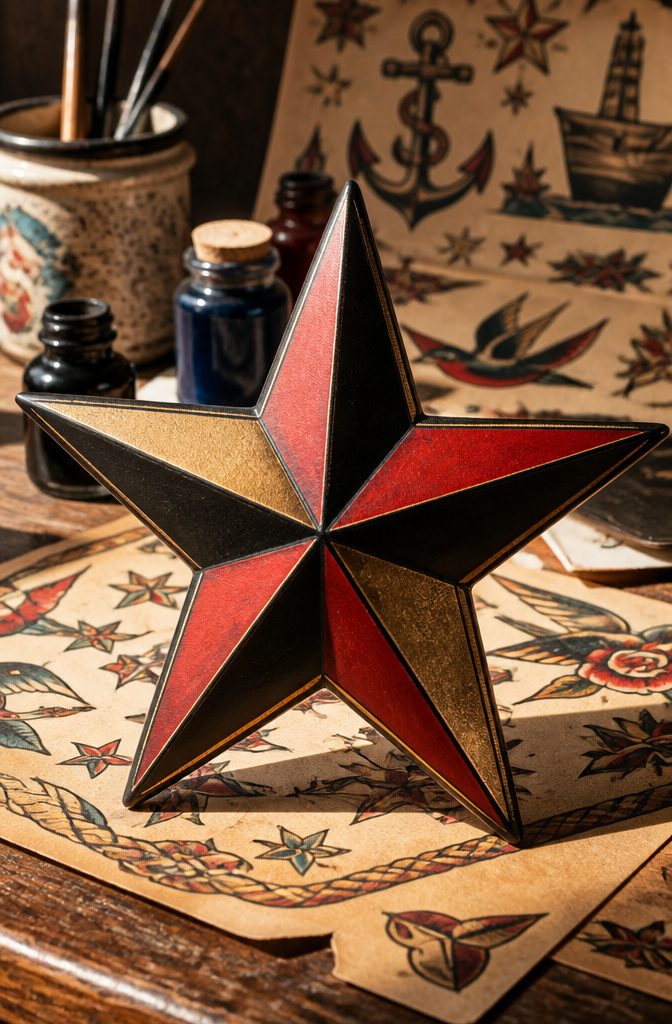
The nautical star started as a practical tool before it became skin art. Sailors inked the five-pointed shape to mark the north star, a fixed point that kept them oriented when open water offered no landmarks.
That meaning, finding direction when everything around you shifts, is what made the design spread beyond the deck and into the parlor.
What keeps it alive in traditional tattoo flash is how little the design needs to work. Two colors, clean symmetry, a strong black outline: the star reads instantly even at palm size or tucked behind an ear.
The format rewards this kind of restraint. Flash sheets were built for quick selection and quicker execution, so a symbol that carries its weight without fine detail fits the system perfectly.
I have seen the same star worn as a stand-alone knuckle piece and as the center of a larger chest panel.
The geometry scales without losing its punch, which is rarer than most people assume when they pick a design off the wall.
Sailors trusted it for safe passage; the rest of us borrowed it for steadiness in whatever voyage we claim.

【Size】 66"wide x 72"high. The standard size is sure to fit most bathtubs and shower stalls

Perfect for admirers of American traditional tattoos, old school tattoos and traditional tattoo graphics. Great if you love getting ink, tattoo flash and tattoo streetwear. Show your love for unique edgy graphics with our retro tattoo-inspired designs.

❤️Authentic American Traditional Vibe | 9 non-repeating temporary tattoo sheets feature iconic old school motifs in classic blackwork style — roses, serpents, daggers, eagles, skulls, anchors and more. With bold weighted linework, they faithfully recreate the vintage tattoo parlor flash aesthetic, giving you an authentic inked look without permanent commitment.
Skulls
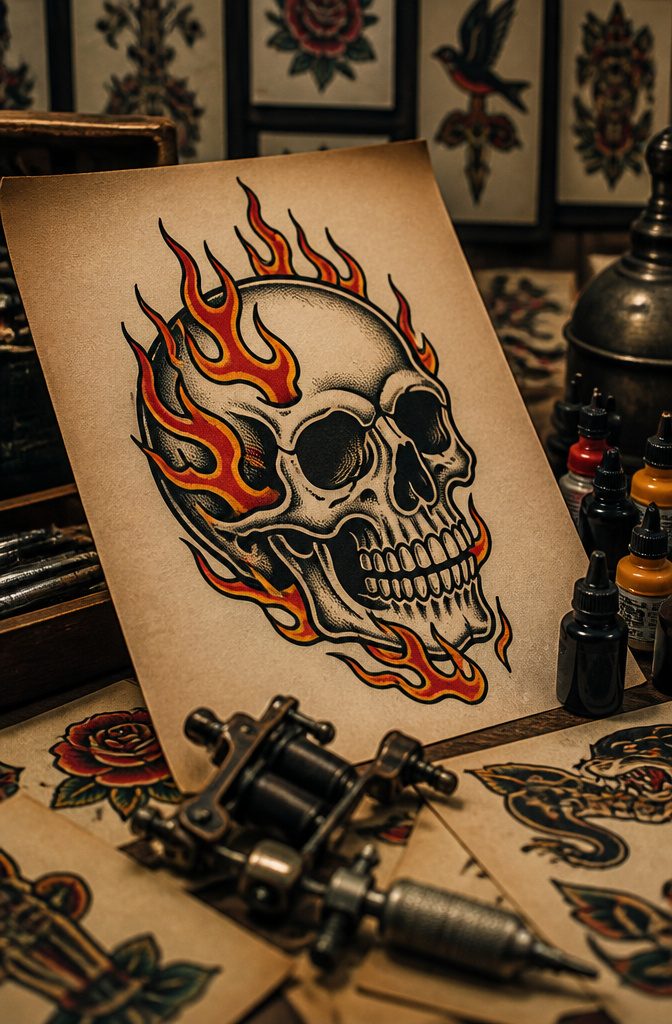
Skulls hit the wall alongside every heart and rose in the flash books, and they did the emotional work the sweeter stuff couldn’t touch.
A bare skull, often just called a memento mori piece in the old sheets, sat there to remind you that the skin itself was temporary.
That balance mattered in shops where a sailor might walk in for his girl’s name and leave with a skull too, the two designs speaking to different hours of the same life.
The recklessness came through in how artists drew them: flames licking the bone, dice in the teeth, sometimes a snake threading the eye socket like it owned the place.
These weren’t meditations on death so much as a shrug at it, the visual equivalent of laughing in a storm.
You see the same tone in later flash when Mexican sugar skull influences crossed north, bright paint and floral patterns turning the skull into something you almost wanted to party with.
The bony structure underneath stayed recognizable, though, keeping that old memento mori anchor even while the colors got cheerful.
Placement in traditional flash usually kept skulls to the upper arm or chest, spots where they read fast from across a room.
The bold black lines carried well and aged cleaner than finer work, which is why so many 30- and 40-year-old skulls still look like themselves today.


High quality fashionable temporary tattoo, which looks like real

Dragons
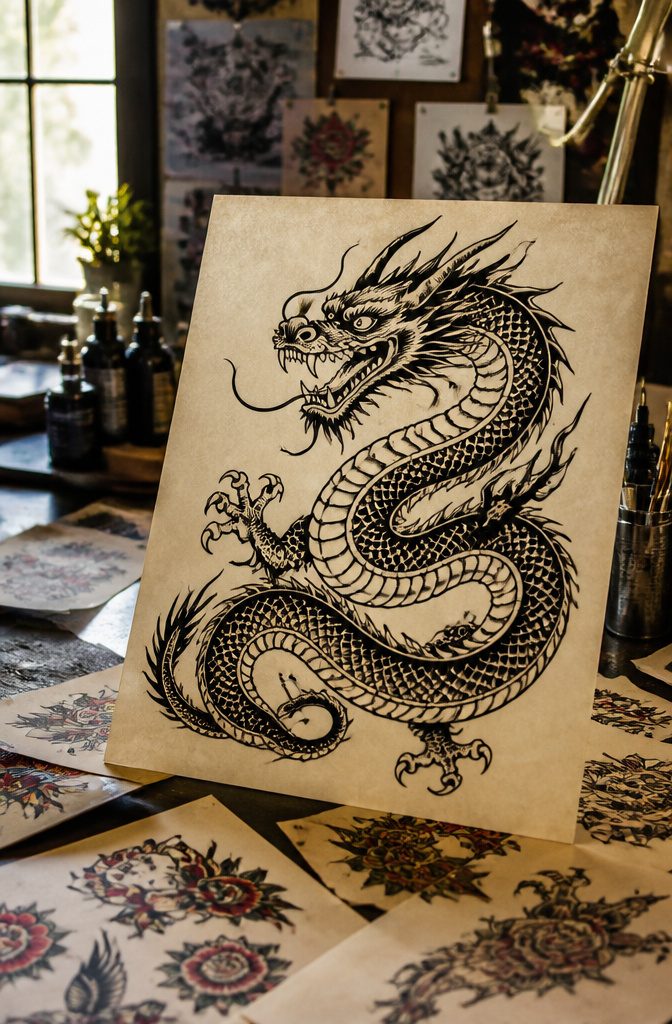
Eastern dragons wound their way into Western flash sheets through sailors pulling into Yokohama and Shanghai half a century before most landlubbers had seen one.
Those men didn’t bring back fine art scrolls. They brought back compact, bold images that could be inked fast and read clear from across a bar.
The traditional tattoo flash version strips the dragon to its essentials: heavy outline, limited palette, claws and flame reduced to a rhythm of positive and negative space.
What gets lost in cultural detail gains in longevity. A 3-inch dragon on a forearm still registers as a dragon at 20 feet because the design sacrifices scales for silhouette.
I have watched collectors pass over flash sheets where the dragon tried to keep too much Asian complexity.
The ones that aged into classics borrowed just enough to signal the source, then translated the rest into the visual grammar of American traditional: thick black line, solid fill, no subtlety that time would blur.
The best old examples look almost crude until you notice how every curve was weighted for skin that moves and stretches.
For placement, the smaller the spot, the more that bold simplification matters. A dragon wrapped around a wrist or tucked behind an ear lives or dies on whether its head and tail remain distinct at a glance.


Classic nautical swallow tattoo with tropical island twist. Bold black outlines, halftone shading, and authentic American traditional styling inspired by timeless sailor flash art.

Sailor Jerry Traitional American Tattoo Flash
Koi Fish
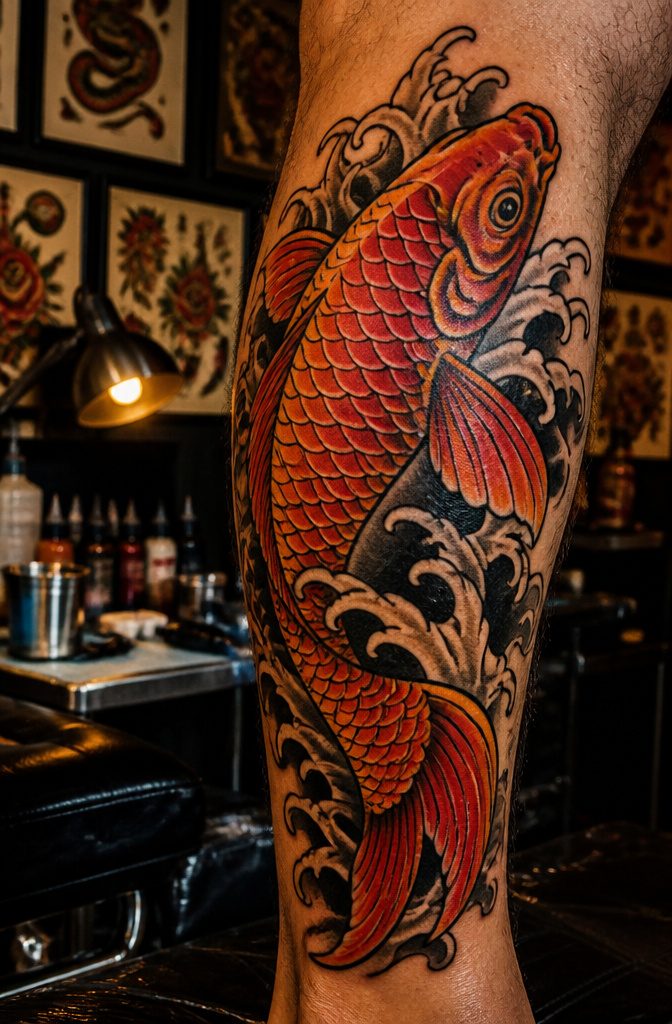
The koi fish swam upstream from Japanese tattooing to anchor itself in American traditional flash somewhere around the mid-century, and the journey changed what it looked like.
In Japanese work, the koi usually carries gradated scales, flowing water, and a sense of motion that fills a back piece or sleeve.
On American flash sheets, the same fish got squeezed into a bold black outline, flat red or orange fills, and a more compact body that could live on a forearm or a calf without losing readability from across the room.
The perseverance symbolism made the trip intact, which is why it sold.
A koi swimming upstream stands for struggle and endurance, and that story translated even when the visual language shifted. American tattooers kept the basic pose, the whiskers, the curved spine, but stripped out the delicate linework and background waves.
What remained was the idea, packaged so a sailor in San Diego or a biker in Chicago could read it instantly.
I have seen vintage flash where the koi gets paired with a skull or a banner in ways that would make a Japanese master wince. That fusion is the point.
The design became American by being less faithful, not more. The flat color and heavy contour let it age hard and still scan as a fish ten years later, which matters more on a flash sheet than anatomical accuracy.

TRADITIONAL FLAIR: Get ready to unleash your inner rebel with Savvi's American Traditional Flash Temporary Tattoo Pouch. Have fun on a wild ride of traditional American flash art with 18 tattoos to choose from.

DESIGN AND ELEMENTS ---- 2 sheets 120×260mm Classic Temporary Tattoo, including vintage roses, tiger, letter, poker, eagle, sword, skeleton and more. Almost unlimited creative combinations and options can meet your various needs.

🖤 108 UNIQUE OLD SCHOOL TATTOOS: 108 different pre-cut old school tattoos featuring roses, flowers, hearts, anchors, daggers, skulls, eagles, swallows and pirate ships. Bold lines and vivid colors create a classic American Traditional look.
Butterflies
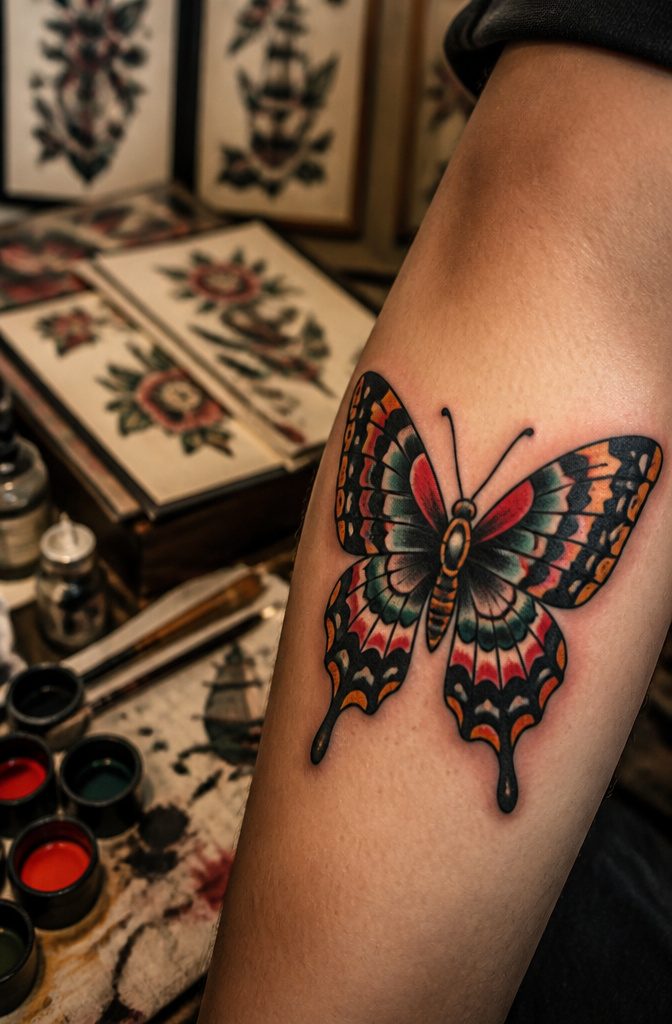
Butterflies sit in that sweet spot where traditional flash keeps the shape readable but lets the color do the talking.
The wings give you two matching planes to work with, and a good sheet will lay them flat enough that the tattoo stays legible even when the arm moves.
My sister picked one off the wall at a shop in Savannah years ago, and the artist had it lined and shaded before she finished her coffee.
That speed matters with flash; the butterfly’s symmetry means less stopping to check balance against a stencil, so the price stays down and the result stays predictable.
Color is where they pull people in. A solid blue or orange reads instantly as butterfly, no second glance needed, and the black outline holds that brightness over time better than wash-heavy styles.
Some women gravitate toward them for the softer association, though I’ve seen plenty on men too, usually smaller and tucked toward the elbow where it plays against harder pieces.
The limitation is placement.
Too large and the wings distort across a shoulder or hip; too small and the antennae blur into gray blobs inside a few years. A palm-sized piece on the inner forearm or just above the ankle keeps the proportions honest.
If you want lifelike detail, look elsewhere. Traditional flash butterflies are pattern first, creature second: three-color wings, a little dotwork body, maybe a leaf or ribbon if the sheet is generous.

【Minimalist Western Boho Style】This semi permanent tattoo set captures the free spirit of the American Southwest with fine-line drawings of cacti, cowboy boots, guitars, and suns, paired with sweet Spanish phrases like "Te Amo." The clean, unfilled outlines create a delicate, boho-chic look that’s effortlessly cool and wearable—perfect for the modern "Coastal Cowgirl" aesthetic that blends desert vibes with everyday ease.

Triple Blackout Tattoo Ink - Strengthen your shading with Triple Blackout, the boldest black designed for greater dimension in your tattoos. With a glycerin free formulation, this professional tattoo ink inserts smoothly into the skin for excellent distribution and shading.

Ultra-Thin Black Ink - This all-around black tattoo ink delivers the thinnest consistency without glycerin, offering super-smooth flow and rapid saturation for high-speed precision during lining and shading.
Eagles
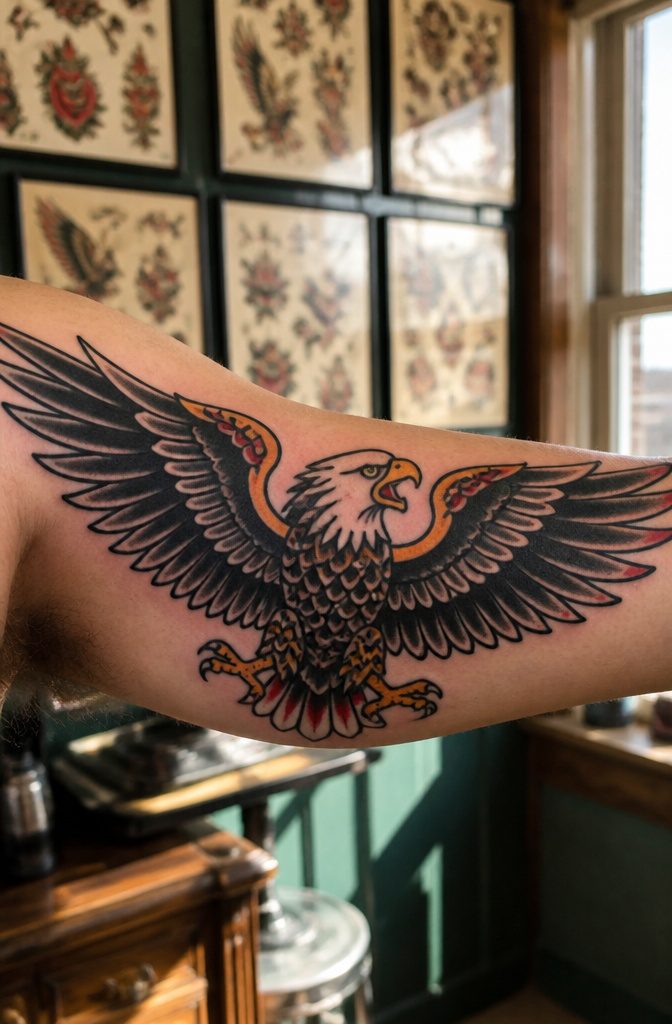
The eagle landed in traditional flash early, and it stayed for reasons that had little to do with sailors.
Military clients in the 1900s wanted the bird spread wide with talons forward, a posture that read as protection and warning at once.
Shop owners learned fast that this profile, framed in bold black with limited red and select blue, filled wall space and moved fast on skin.
The color limit mattered. Early twentieth century pigments were unreliable; red faded fastest, blue held middling, black stayed legible for decades.
A smart flash sheet rendered the eagle’s body in dense black line, used red for the beak and perhaps a banner, saved blue for a field of stars or a lone ribbon.
The design still reads at fifty years because the contrast was built for endurance, not for photographic subtlety.
Painters like Sailor Jerry Collins refined the form without softening it. His eagles carried the same spread wings, same fierce profile, but the line weight carried muscle memory from years of repetition.
The look became parlor standard because it worked on biceps, chests, backs: large enough to hold detail, simple enough to finish in a single session that a sailor on leave could afford.
Ship Wheels
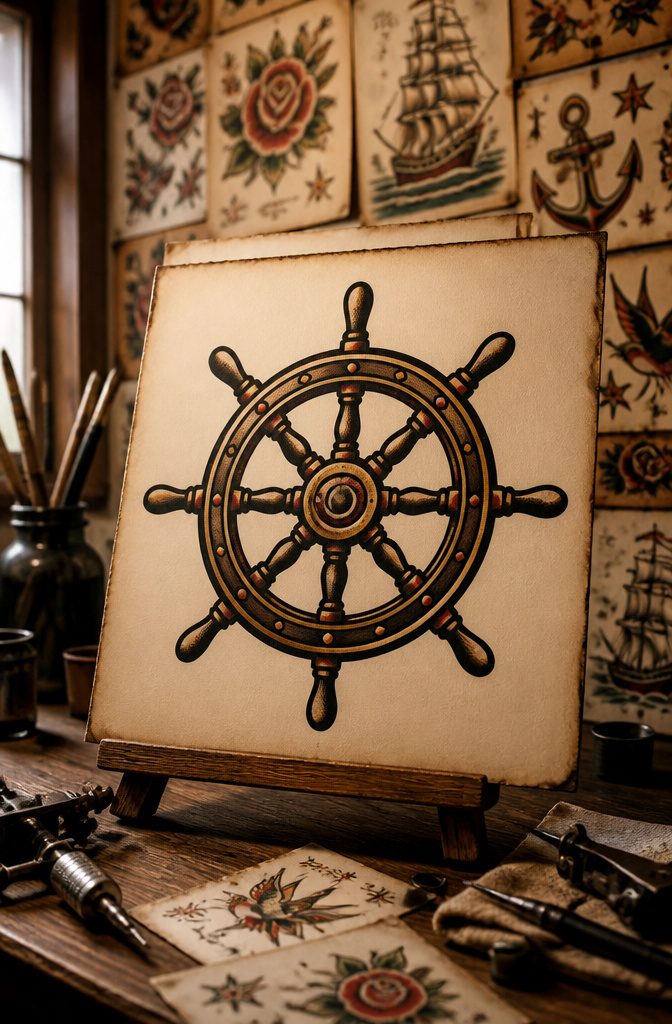
Ship wheels sit at the center of nearly every sailor’s arm or chest piece, and that round format is the reason they became a staple of traditional tattoo flash.
The circle nests perfectly into a shoulder cap or cups over a knee, two spots where a spinning wheel actually makes visual sense with the body in motion.
The spokes radiate outward, which gives the artist natural lines to work with, not against.
The wheel itself is navigation imagery in the most direct sense, and it pairs hard with the anchor and the nautical star that usually flank it.
As a set, they tell a complete story: the anchor holds you steady, the star points direction, and the wheel puts your own hand on where you go next.
That last part is why the design outlived its sailor roots. The meaning of steering your own course translates clean to anyone walking into a shop in Kansas or Kentucky, nowhere near salt water.
The wheel still reads, and that is the test for flash that hangs on a wall for fifty years.
Fantasy Creatures
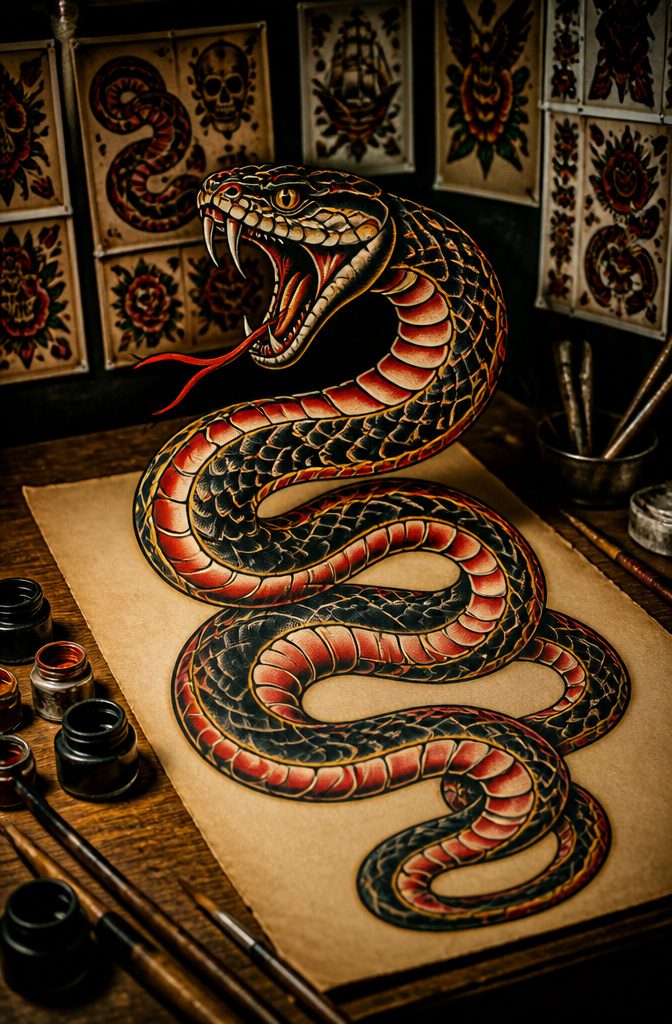
Snakes wound through flash sheets with jaws unhinged far past anything a real python could manage, and that was the point. The exaggeration let an artist prove they could hold anatomy together while pushing it past belief.
Panthers stretched across bicep caps with claws splayed to the width of the whole muscle, bodies fluid as spilled ink, eyes narrowed to slanted slits that read as menacing from across a room.
The pose had to carry the wallop, because color stayed locked in a narrow set of rules.
These creatures gave the artist somewhere to show off without breaking tradition. A coiled serpent could fill a chest panel with enough curves and counter-curves to test line confidence for hours.
Wings, when they appeared on griffins or hybrid beasts, got simplified to bold stripes of feather shapes, readable at the small scale of a street-shop window.
The convention kept the design honest to its era, but within those borders, the battle between restraint and showmanship is what makes the sheets worth studying now.
Vintage Flash Revival
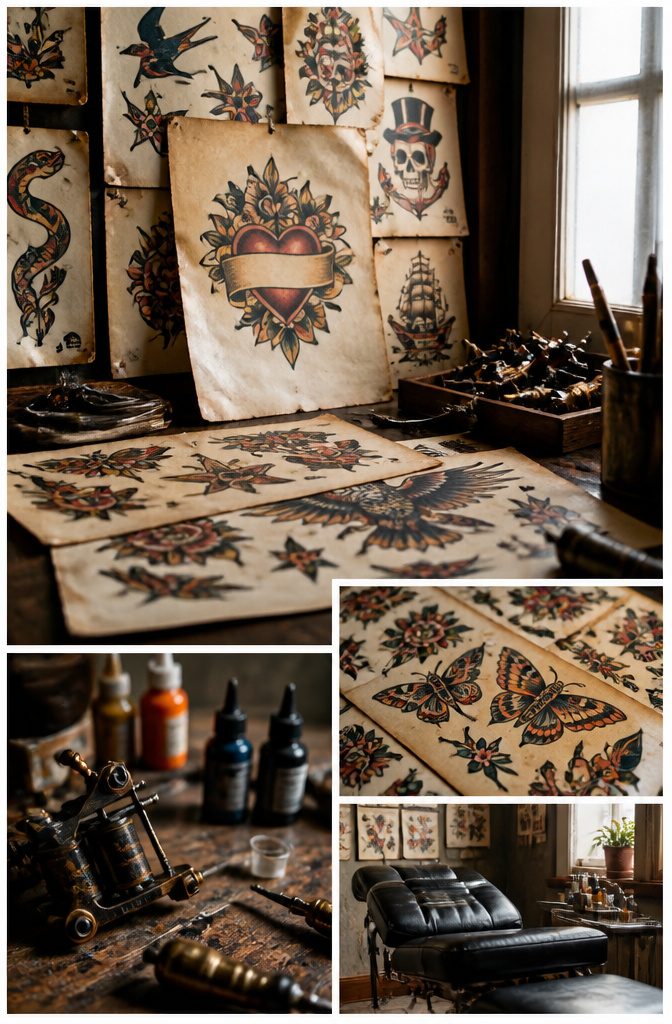
Dice, bottles, banners, and old script styles are climbing walls again right alongside the birds and roses everyone expects. I watch collectors fight over original flash sheets at auctions now, treating them like blueprints of who we were.
A 1900s banner with hand-lettered "Mother" carries the same weight as a signed band poster, maybe more, because the artist was marking working skin, not paper for the wall.
The lettering alone tells a whole story. That thick, tilted serif style, the one that reads like a shout even at two inches tall, came from sign painters who figured out what held up when the skin aged.
I spent months trying to spot the difference between a faithful reproduction and a modern riff that misses the weight of the stroke. The originals pressed down harder.
The ink sat heavier. You can feel it in the paper if you handle one.
Collectors now want the sheets intact, sellotape stains and cigarette burns included.
That damage proves the thing lived in a real shop, hung where apprentices stared while they waited to learn. A clean sheet that lived in a drawer is worth less than a dog-eared corner someone once tacked above a mirror.
Origins of Tattoo Flash
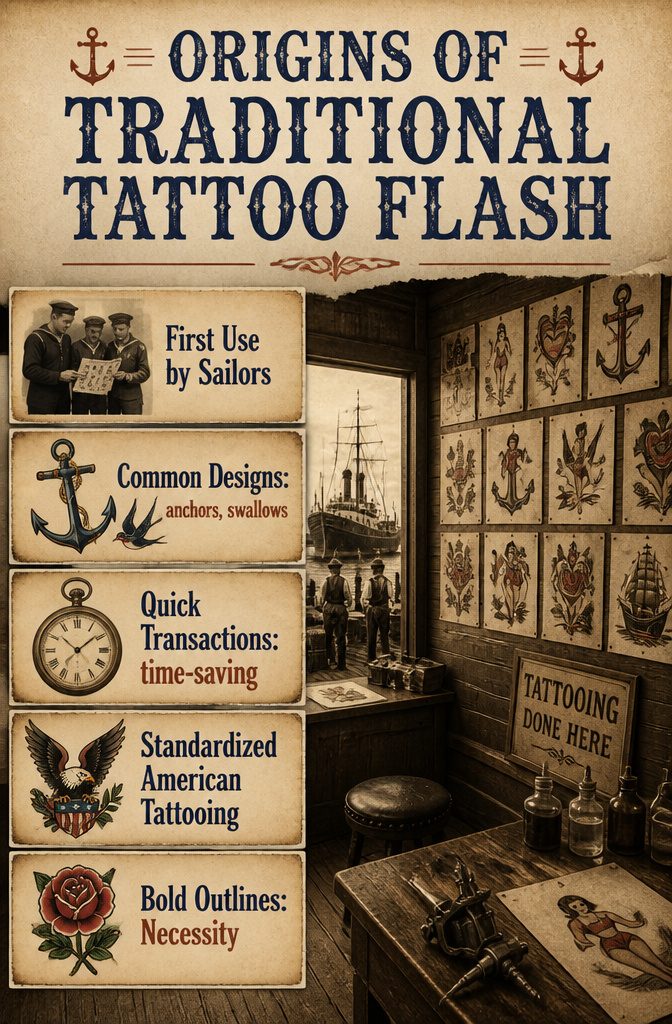
Early sailors carried the first flash ashore in the early 1900s, walking into waterfront parlors with ports like Honolulu or San Francisco and pointing to pre-drawn sheets of anchors, hearts, swallows, and pin-ups already tacked to the walls.
The word itself comes from the speed of the transaction: a design that could be flashed up, sized, and needled into the skin in the short hours before a ship sailed.
Those sheets standardized American tattooing in ways that still show.
Before flash, every piece was drawn bespoke; after it, a sailor in 1910 and a dockworker in 1930 might wear the same eagle from the same printer’s catalog, and both would know the image at a glance.
Norman "Sailor Jerry" Collins and Don Ed Hardy built their later fame on this foundation, but the system they worked within came earlier: wall-sized sheets of transferable art that let a stranger pick, point, and pay without ever meeting the artist’s pen.
The result was a visual language shared across coasts, where bold outlines and limited palettes were not merely style but necessity, the only marks that would read clearly when copied fast and often.
Iconic Imagery and Symbolism
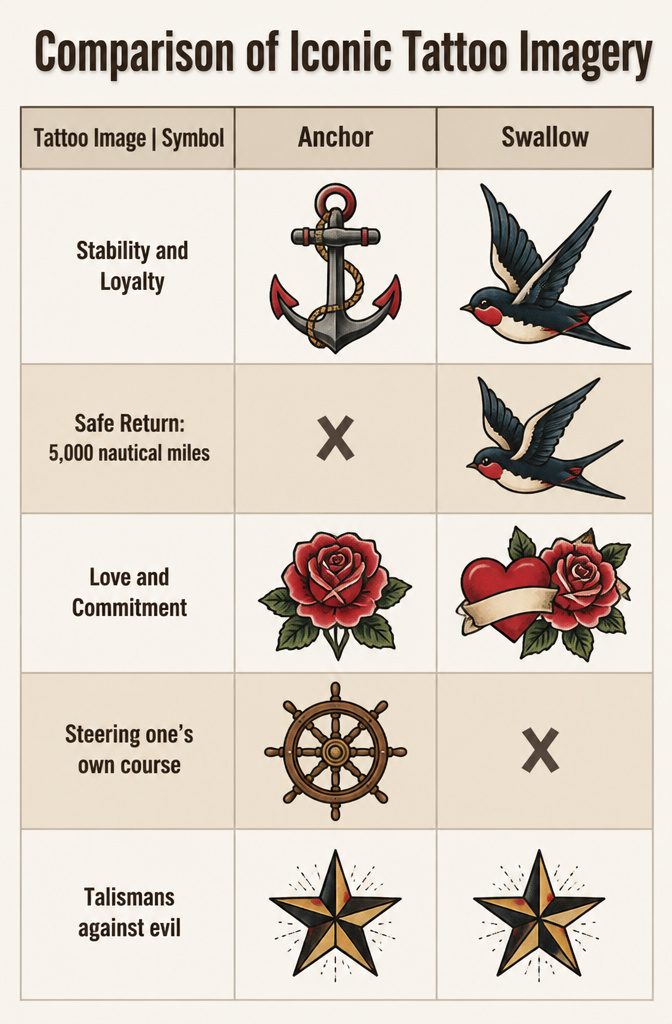
Traditional tattoo flash built a vocabulary anyone in port could read. An anchor on a forearm meant stability and loyalty to the crew and the ship.
A swallow mapped onto skin after a sailor had sailed 5,000 nautical miles marked safe return, and two swallows meant he made it home twice. Roses climbed beside hearts as proof of a love that was supposed to outlast the voyage.
This shared code let sailors state experience without speaking it. A ship wheel meant the wearer steered his own course, or wanted to.
Nautical stars were talismans against evil spirits and bad luck at sea. Behind the bright paint on flash sheets, these marks worked as résumé and ID at once.
A stranger at the bar in Singapore or San Diego could read the symbols and know roughly where a sailor had been, what he valued, and whether he had survived enough water to earn his birds.
The system depended on repetition. Anchors, swallows, roses: the same images repeated so often that they became a language, not a style choice.
Customers picked from sheets on the wall, so the art stayed recognizable across oceans and decades. That mutual understanding is what separates old flash from nostalgia: it was functional communication, not decoration, before it ever hung framed in someone’s apartment.
Evolution of Styles
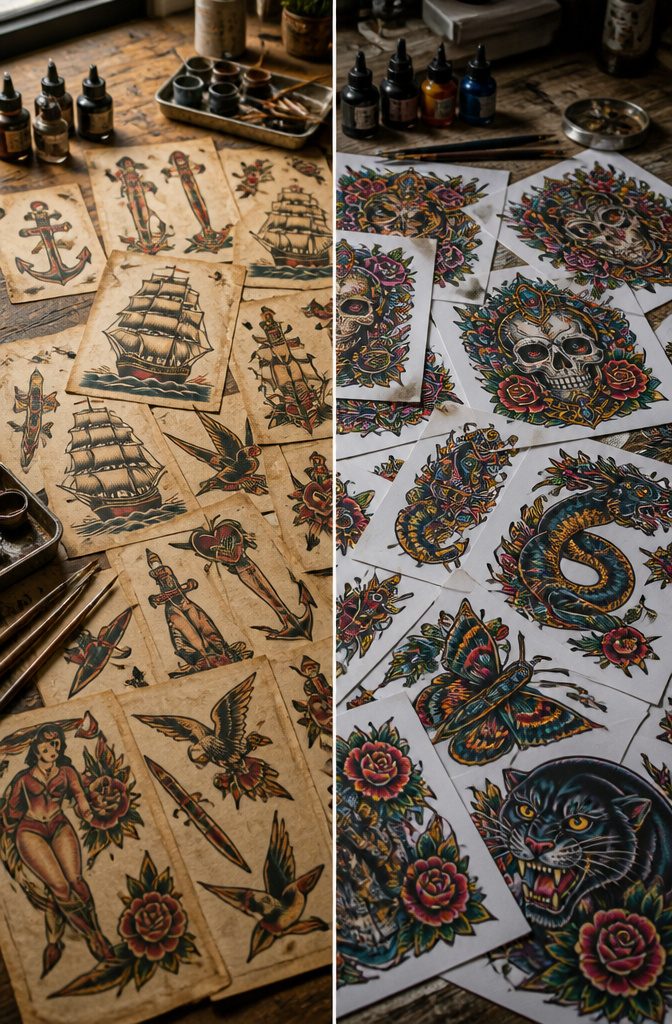
Sailor Jerry built the grammar of American flash, and his sheets still read like they were drawn yesterday.
Bold outlines stayed non-negotiable through every shift that followed, because a tattoo on a rolling ship’s deck or a bouncing thigh had to hold its shape at distance and at age.
Limited palettes weren’t an artistic choice alone; fewer colors meant fewer variables that could blur or fade unevenly.
Ed Hardy pushed Japanese influence into that framework. Apprenticed under Sailor Jerry’s lineage before he ever touched tebori, Hardy folded in dragons and koi from ukiyo-e and Horiyoshi III’s living tradition.
The blackwork grew more intricate, the compositions asymmetrical where Jerry had favored balance, but the lines stayed bold and the color count stayed disciplined.
Today’s neo-traditional artists stretch the same bones. They’ll shade a skull with gradients Jerry never touched, or frame a panther in decorative filigree that nods to Hardy’s scroll paintings.
What breaks is the restraint, not the readability. A neo-traditional sleeve can run two dozen colors where Jerry used four or five, but the silhouette still drops clean against skin from across a room.
That consistency matters when you’re choosing between a reproduction sheet and something contemporary.
Either way, the design should scan in half a second. If it needs explanation, it’s missed the point of flash entirely.
Frequently Asked Questions
What is traditional flash tattoo?
Traditional flash tattoo is a style that took shape in early 1900s American parlors, built from bold black outlines, flat limited colors, and iconic imagery like anchors, swallows, and roses.
The designs came pre-drawn on sheets hung shop walls so customers could point, pay, and get inked fast, often before a ship sailed.
That speed gave the form its name and its look: shapes simple enough to read across a room and still hold up after decades of sun and aging skin.
What is the name of old school tattoos?
Old school tattoos are simply called traditional tattoos, or American traditional tattoos when you want to mark the specific lineage.
The terms swap cleanly in most shops and collector talk, both pointing to the same bold-line, limited-palette style born in waterfront parlors a century back.
Why are they called flash tattoos?
The word "flash" came from the speed of the transaction: a design that could be flashed up on the wall, sized, and needled into skin in the short hours before a ship left port.
Those pre-drawn sheets let a stranger walk in and pick without ever meeting the artist’s pen, standardizing American tattooing across coasts.
The term stuck to the sheets themselves, and later to any quick-pick wall art, though modern marketing has sometimes borrowed it for temporary metallic body stickers that shine from different angles.